by Nelly's Sports
Thursday, Jul 30, 2026The calendar flips to August soon, and pitchers who've spent the mid-summer month outrunning their peripherals are running low on room to hide. These four American League starters have posted results that look considerably better than the underlying process, and each profiles as a fade candidate in upcoming spots.
Brandon Young – Baltimore Orioles
Brandon Young has been one of the season's genuine surprise stories, carrying an 8-2 record and a 3.25 ERA into his 16th start with a solid strikeout profile across over 91 innings. It's a legitimate breakout for a 27-year-old who was optioned to Triple-A as recently as March and battled a 5.01 ERA in limited big-league time opportunities last season. The contact quality tells a more measured story: an 89.4 mph average exit velocity and 41.8% hard-hit rate leave Young's .313 expected wOBA a shade above his actual .301 mark, and his overall strikeout-minus-walk rate has sat in the high single digits for most of the year for a level that typically doesn't support such a strong ERA. Young has benefited from a reworked splitter that's picked up velocity separation and depth as the summer's worn on, and that's a real skill gain worth crediting. Still, a five-pitch arsenal with no plus offering is a thin margin to sustain a sub-3.30 ERA into August, especially as lineups get a second and third look at him late in the season.
Griffin Jax – Tampa Bay Rays
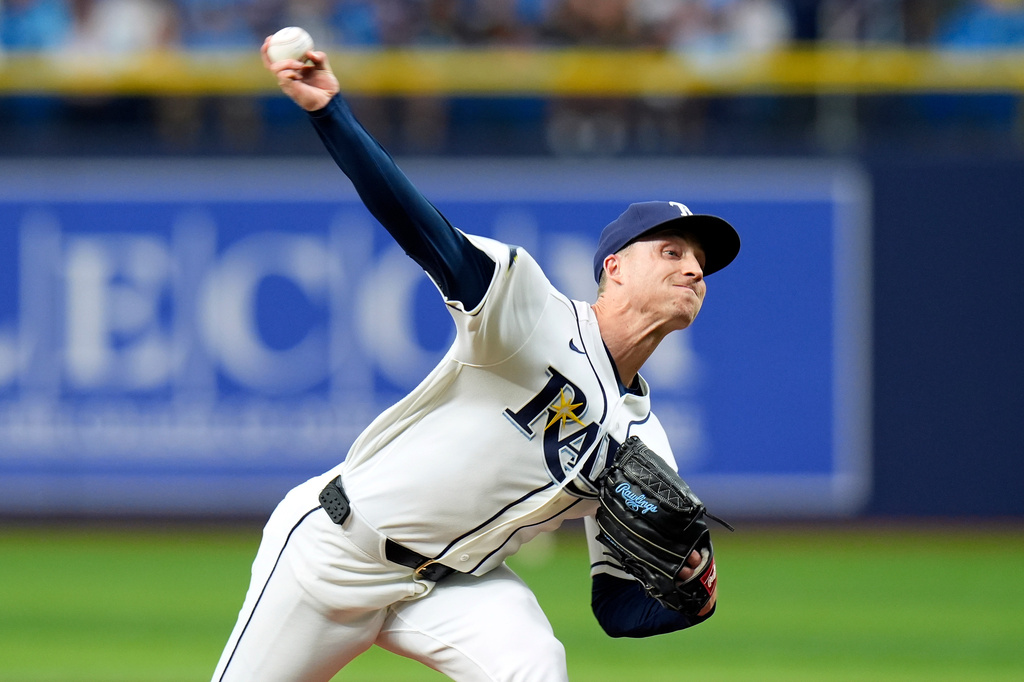
The Griffin Jax transformation story has been an intriguing subplot this summer for the AL-leading Rays. A reliever who couldn't find a home in Minnesota's bullpen is now anchoring Tampa Bay's rotation after being acquired for Taj Bradley. Jax opened his starting stint with a jaw-dropping 1.42 ERA across his first several outings, and while he's cooled since, he still sits with ERA below 4.00 with a solid WHIP. The concern for Jax moving forward is what's happening on contact: an 88.8 mph average exit velocity and 39.9% hard-hit rate have produced a .343 expected wOBA against, more than 30 points higher than his actual .311 mark allowed. His Stuff+ grades have also slipped over the past month as his workload climbs into unfamiliar territory for a pitcher who's thrown mostly relief innings the past four seasons. The Rays deserve credit for reinventing Jax as a starter, but the underlying batted-ball data suggests hitters have been squaring him up more than the results show, and that gap tends to close as a season wears on.
Tanner Bibee – Cleveland Guardians
After a disappointing start to the season, Bibee has quietly stitched together a respectable 3.89 ERA and 1.18 WHIP with a 2.6 strikeout-to-walk ratio across 125 innings, and he's tied for third-most quality starts in the American League. The results look like a bounce-back from a disappointing 2025 season that saw his home run rate spike. The problem is the home run issue hasn't gone away, Bibee has continued to give up more hard contact and long balls than his strikeout gains would suggest he should, and earlier-season readings had his FIP running close to a full run higher than his ERA. That's the profile of a pitcher benefiting from timing and sequencing rather than a durable step forward in stuff. Cleveland's strong defensive positioning behind him has masked some of the damage, but the underlying contact-management concerns from a year ago haven't disappeared, just been offset by better luck on balls in play.
Erick Fedde – Chicago White Sox
Fedde has been a streaky watch all season, and his surface numbers (4.16 ERA through 93.2 innings, 66 strikeouts) obscure a rockier underlying picture. Earlier in the year his FIP ran multiple runs higher than his ERA thanks to a home-run rate that spiked even as his strikeout rate slid closer to his difficult 2025 form than his strong 2024 debut with the club. His current Statcast profile with an 88.7 mph average exit velocity, 38.7% hard-hit rate, and a .334 expected wOBA nearly matching his .341 actual mark, suggests the correction has already been partially priced in. A five-pitch mix that leans on called strikes rather than whiffs leaves him vulnerable to contact-driven innings blowing up in a hurry. Treat him as a game-to-game read rather than a set-and-forget arm the rest of the way.
