by Hollywood Sports
Monday, Aug 31, 2026For the 16th straight summer, I invested time researching each FBS college football team to serve as the foundation for my college football handicapping in the fall and winter. What initially began as basic note-taking on some fundamental details for each team has become an arduous and detailed process for each team that derives from reading and studying multiple sources. Each FBS team now takes about 45 minutes to an hour of preparation time.
To help document this work while crystallizing my thoughts for each team, I am providing a summary of each team highlighted by a critical question that will go a long way in their success or failure.
ALABAMA: After missing the playoffs in head coach Kalen Deboer’s first season running the program, the Crimson Tide made the playoffs as a bubble team last year — and they then beat Oklahoma on the road in the first round. But Alabama was simply outclassed in the quarterfinals at Indiana by a 38-3 score — and that continued a disturbing trend that rarely happened in the Nick Saban era. The Crimson Tide also got spanked in the SEC Championship Game against Georgia by a 28-7 score. After losing to Oklahoma by a 24-3 score in DeBoer’s first year in Tuscaloosa and opening last season with a 31-17 loss against Florida State, Alabama has already racked up four losses by double digits since DeBoer took over. There are significant concerns on both sides of the line of scrimmage. After losing four of his top five defensive linemen either to the NFL or the transfer portal, DeBoer had to rely on the portal to bring in his likely starting three in defensive coordinator Kane Wommack’s 3-3-5 scheme. At least that could address the size problem as Alabama got pushed around by the Bulldogs and Hoosiers in those late-season losses. The offensive line lost six of their top seven on the depth chart last year. DeBoer brought in six transfers, but only two were starters from FBS programs. Depth at the line of scrimmage was simply never an issue under Saban. Perhaps this is simply the fallout from losing more than 30 players in the portal after Saban's surprise retirement two years ago? On paper, DeBoer is recruiting well — but the state of the offensive and defensive line has been the biggest decline in excellence in the post-Saban era. This has manifested itself in a dreadful running game under DeBoer. The Crimson Tide’s 4.4 Yards-Per-Carry average from running backs in the last two seasons is the eighth lowest of all Power Conference programs. Their 3.4 Yards-Per-Carry team mark last year was the third-worst for this program since 1970. They ranked 123rd in the nation by generating only 104.1 rushing Yards-Per-Game last season. In their losses to Georgia and Indiana, they rushed for a mere 20 combined yards. There is blue-chip talent in the running back room, but perhaps the offensive line is simply the Achilles heel to get the ground game going. This failure to run the ball effectively may also be endemic to executing Air Raid concepts against top-level defenses with elite size on the defensive line like many of the programs in the SEC and Big Ten — there is a reason why the Air Raid is not a popular scheme in either power conference. I’m not in love with offensive coordinator Ryan Grubb as a play-caller, either. Three of the top four targets in the passing game are gone. Junior Ryan Coleman-Williams is still around — but he led all high-targeted wide receivers last year with a drop rate of 13.0% of the passes directed at him (but perhaps adding the “Coleman” to his last name will solve his dropsies problem?). Only six players remain on the roster from the Saban era. This is DeBoer’s team — and it looks as if he is giving the keys to the offense to five-star redshirt freshman Keelon Russell after he starred in spring practice. The talent remains mostly elite. But perhaps expecting the uber-high standards established in Saban’s tenure was simply too much to ask.
AUBURN: For the fifth straight season, the Tigers suffered a losing season as they settled for a 5-7 record last year. Third-year head coach Hugh Freeze was fired on November 2nd. The biggest problem is this football team’s inability to win close games. Auburn lost all six of their games decided by one scoring possession last year — and they have now lost 12 of their last 13 contests decided by eight points or less. While they finished only 1-7 against SEC opponents, they were only outgained by -7.0 net Yards-Per-Game. In their 2-6 conference campaign two years ago, they outgained their SEC rivals by +62 net YPG. It’s fair to conclude the fundamental problem was a losing culture under Freeze after his last tenure in the SEC with Ole Miss ended in less-than-endearing results. In comes South Florida head coach Alex Goresh for the last three seasons. After inheriting a Bulls squad that had lost 49 of their last 53 games, they went 23-16 in his three-year tenure. As is the tactic, Goresh brought in 11 key players from the Bulls to meld with this Tigers team that returns only four starters. The key player is senior quarterback Byrun Brown. The dual-threat quarterback passed for 3158 yards last season and added 1121 non-sack rushing yards — and he accounted for 42 touchdowns with his arm and his legs. Three of his targets in the passing game came over in the portal. The Tigers have finished outside the top 50 in scoring and outside the top 50 in ESPN’s Bill Connelly SP+ top 40 rankings since 2019. Perhaps continuity on offense from all these South Florida players and their offensive coordinator Joel Gordon for the last three seasons will give that side of the ball the spark it needs. The defense is in pretty good shape — and Golesh was smart to retain defensive coordinator D.J. Durkin for his third year running that side of the ball. Auburn has ranked in the top 20 in the SP+ defensive rankings in two straight seasons. They do have to replace defensive ends Kendric Faulk and Keyron Crawford, who got drafted in the first and third rounds of the NFL draft. Durkin lost six of his top eight tacklers and eight of the ten players who logged in at least 300 snaps. But if Golesh can bring juice and confidence on his side of the ball, the ceiling becomes much higher for this program if they can start winning more of these close games.
BALL STATE: It took first-year head coach Mike Uremovich only nine games to reach four wins and match the team’s season high in the previous two seasons. The administration appears to have made a good hire after he turned a struggling FCS Butler program around with a 23-11 record in his three seasons. The former Temple and Northern Illinois offensive coordinator is a familiar face for high school coaches in Indiana. But the Cardinals lost their final three games by an average of -21.6 Points-Per-Game to end the season with a 4-8 mark. Talent is the biggest obstacle to turning around this program that has not had a winning record since the 2020 COVID-impacted season. That was Ball State’s only winning season since 2014. Despite a 3-5 record in conference play, the Cardinals got outgained by -122 YPG against fellow Mid-American Conference opponents. On the road, they got outgained by -195 YPG, with their average losing score being 36-10. Only seven starters return, but Uremovich was active in the transfer portal, bringing in 25 new players either looking for playing time from other FBS programs or looking to succeed at the FBS level after competing for FCS or Division II football teams.
BAYLOR: Ever since the Bears won the Big 12 Championship in 2021, my seasonal deep dives into this team have included speculation regarding whether that achievement was a fluke under head coach Dave Aranda. After last season’s 5-7 campaign, Baylor has a 22-28 record with only one winning season. After missing the postseason last year, they have only played in two bowl games in the last four seasons. Frankly, Aranda probably is out of a job if not for the Baylor administration first firing athletic director Mack Rhoades late in the football season and seemingly kicking the can on the fate of their football coach until they brought in their next athletic director. If there is a head coach sitting on a hotter seat, I do not know who that is. As I seem to point out every year at this time: “Aranda’s stamp should be on the defensive side of the ball after previously serving as the defensive coordinator at LSU — and there seems to be a disconnect between his schemes with the Tigers and the game plans now with the Bears.” His defense hit rock bottom three years ago by ranking 113th and 110th by surrendering 33.3 Points-Per-Game and 421.3 total Yards-Per-Game. The “fix” two years ago was for Aranda to call the defensive plays while also coaching the linebackers. But the Baylor defense only took small steps forward by surrendering 386.2 total YPG (87th in the FBS) and ranking 63rd in ESPN’s Bill Connelly’s SP+ defensive ratings. In terms of total yardage, only one of Aranda’s defenses has ranked inside the top 48 in the nation in his five years. Last year, the Bears surrendered 392.1 total YPG, which resulted in 32.6 PPG, ranking 87th and 120th in the nation. They gave up 197.2 rushing YPG, which was the 120th worst in the nation — and there simply is not a Power Four conference opponent that can function effectively if their opponents are averaging 4.9 Yards-Per-Carry. As always for Aranda, he is making changes — and this time it will be different! He has removed himself from calling plays on defense, with this being rationalized as him now being able to help coach the coaches and better evaluate the players, as if that was not the plan in the first four years of his tenure. Admittedly, bringing Joe Klanderman as his defensive coordinator is more than solid — he has been the defensive coordinator at Kansas State the last six seasons. Four starters are back on that side of the ball — and Aranda added ten players in the transfer portal who had starts at the FBS level last year, including five defensive players who were Wildcats who played for Klanderman. Aranda probably saved his job two years ago when he tapped Joe Spavital from California to be his offensive coordinator. The special teams and offense were quite good last year — the Bears generated 451.1 total YPG, which resulted in 31.1 PPG, ranking 18th and 33rd in the nation. Aranda was able to bring in former five-star blue-chipper D.J. Lagway as the starting quarterback after two inconsistent seasons with some nice highs but some ugly lows at Florida. But only three of the 16 players who logged in at least 200 snaps on offense are back. Once again, Baylor is relying heavily on the transfer portal. Aranda is not succeeding enough at high school recruiting and sustaining a good culture. Four of the top five wide receivers and their top tight end are gone from last year. But the running back room is intriguing with young blue-chip talent. Aranda had to rely on the transfer portal for an offensive line that lost four of their five starters from last year. With 15 starters back last season, 2025 was supposed to be the year when the program returned to the glory days of 2021. In their Big 12 championship run in 2021, an opportunistic defense helped them rank tied for sixth in the country with a +12 net turnover margin — but they only ranked 31st in total defense by giving up 345.9 total YPG. Last year, the Bears were tied for the second-worst turnover margin at -13. As I wrote in my deep dive last year: “While there may be a problem matching his sophisticated schemes with the talent on the roster, there are significant problems in both recruiting high-end talent and simple player development for those on the roster … Baylor will likely go only as far as their defense allows them.” I appreciate Aranda continuing to tinker and moving away from calling plays again, but that is probably his strength as a football coach. The talk is that he is socially awkward, which may explain the leadership and culture issues for this program in Waco. Aranda would not be the first football coach who was simply a better fit as a coordinator than a head coach.
BOISE STATE: It’s getting harder and harder not to simply treat the Broncos as flat-track bullies that get exposed against better competition. In their nine victories last season, they scored 42.2 Points-Per-Game and held their opponents to 21.1 PPG. But in their five losses, they only scored 7.6 PPG and surrendered 29.4 PPG. Boise State considered themselves playoff contenders last year after returning 15 starters from the squad that finished 12-2 and hosted a quarterfinal contest in the College Football Playoffs. Losing five times was a disappointment, although they did win their third straight Mountain West Conference title. Now they make the move to the refurbished Pac-12, where they will be considered the favorites once again. But they have lost 10 straight games against teams from Power Four conferences. Eleven starters are back, headlined by senior quarterback Maddux Madsen. He was considered a game manager two years ago with the Broncos offense resting on the shoulders of running back Ashton Jeanty. With the offense more in his hands last season and not facing stacked boxes focused on trying to slow down Jeanty, Madsen was inefficient, completing only 58.3% of his passes — and he made too many mistakes. It should be noted that he got injured early in an eventual loss at Fresno State. He missed the next four games, including a 10-point loss at San Diego State. He lost his top four receivers from last season. Five of eight offensive linemen that started games last season are back, along with running backs Dylan Riley and Sire Gaines, who combined to rush for 1977 yards as they replaced Jeanty’s production via committee. The defense returns four starters from a group that forced their opponents to gain the third most yardage on third down in the nation — and that helped them rank 23rd by holding their opponents to just a 33.7% conversion rate on third down. But Boise State’s toughness inside was a challenge as they allowed their opponents to rush for 164.1 YPG, ranking 84th in the nation. The Broncos also only registered 27 sacks after gathering 53 sacks the year before. Four starters are back in their front six — but they lost four of their starting defensive backs in their base nickel formation.
BOSTON COLLEGE: I was not particularly optimistic about the Eagles’ prospects in the second season under former Houston Texans’ head coach Bill O’Brien. In my deep dive on this team last year, I wrote: “But losses on both lines of scrimmage may make returning to a bowl game a challenge. The Eagles must replace three NFL-caliber offensive linemen. On their defensive line, only one starter returns — and the loss of ACC Defensive Player of the Year, Donovan Ezeiruaka, and his 16.5 sacks is massive. O’Brien brought in seven transfers, but five come from smaller schools with not much of a resume. The starting quarterback remains unsettled …” In hindsight, I did not expect Boston College to completely collapse to a 2-10 record last season. Injuries played a role, as they usually do. The Eagles were unfortunate to suffer -9 net turnovers for the season — and they lost all three of their games decided by seven points or less. But bad fortune alone can not explain Boston College losing 15 of their last 20 games under O’Brien, who dumped three-fourths of his assistant coaching staff in the offseason. Well, who is the bum who hired those guys? O’Brien also lost 30 players in the transfer portal, including his top running back Turbo Richard to Indiana and his top wide receiver Reed Harris to Arizona State. Not great, Bob. The 28 players O’Brien brought in via the transfer portal are the most in program history. The keys to the offense will likely be handed to Saginaw State transfer Mason McKenzie. The dual-threat quarterback is drawing comparisons to Ole Miss’ Trinidad Chambliss, who won the Great Lakes Intercollegiate Athletic Conference Player of the Year award prior to him winning last year — but Division II QB’s making the successful jump to a Power Four conference is still the exception rather than the rule. O’Brien is now calling the plays on offense, which is not necessarily a good thing. He turned to the 62-year-old Ted Roof to be his next defensive coordinator. The former Duke head coach from 2003-2007 is a well-traveled defensive coordinator in college football, although the last time he oversaw a very good defense was last decade. The Eagles got outgained by -103 net Yards-Per-Game last season against ACC competition, the second-worst mark in the conference. It is difficult to assume the roster is better this season.
CINCINNATI: On the one hand, the Bearcats enjoyed their best season in head coach Scott Satterfield’s three-year tenure by posting a 7-6 record and their first bowl appearance in his tenure. But he had his best roster yet with this program, so the results are quite underwhelming if that is what the ceiling is going to look like. He returns only five starters from that team. There are plenty of red flags. After a 7-1 start, Cincinnati lost their final five games of the season — and that came on the heels of them losing their final five games in the 2024 season to spoil a 5-2 start. One of the silver linings from that 2024 team was that at least the Bearcats outgained their Big 12 opponents by +26 net Yards-Per-Game, despite a 3-6 record in conference play. But Cincinnati’s 5-4 record in the Big 12 last year was betrayed by them getting outgained by -30 net YPG. Frankly, I have significant concerns about Satterfield, who had great success at Appalachian State before a troubling tenure at Louisville with many of the same problems he is encountering now. Under his leadership, the Bearcats are losing in the transfer portal. He lost his starting quarterback, his top two running backs, and top five wide receivers from last season. Only one starter returns on defense, with free safety Christian Harrison and nickelback Jaquan Sanks leaving in the transfer portal. Many of these losses were because of graduation. The defense must replace nose tackle Dontay Corleone and linebacker Jake Golday to the NFL. But the Cincinnati defense ranked 93rd in the nation by giving up 399.2 total Yards-Per-Game, even with two players who later got drafted into the NFL. That group only registered 21 sacks, intercepted two passes, and recovered 12 fumbles. They gave up 37 Points-Per-Game in their final four games. Satterfield fired defensive coordinator Tyson Veidt in the offseason and tapped Nate Woody as his third defensive coordinator in four years. Woody oversaw some great defenses in his six years running the Army defense — but he did not have success in his one season in a power conference at Georgia Tech in 2018. Woody promises an aggressive and attacking pressure scheme — but that’s what everyone says. Satterfield also sacked offensive coordinator Brad Glenn after three seasons and promoted quarterbacks coach Pete Thomas and offensive line coach Nic Cardwell to implement an offensive scheme that fits the personnel — which begs the question of why they were not doing that before now. Satterfield is running out of excuses — but whether a program like Cincinnati can be successful in the Big 12 may be the ultimate question. The Bearcats made the four-team college football playoff just five seasons ago. A year later, Luke Fickell left the program to take the head coaching job at Wisconsin in a move that perhaps should have been seen as the canary in the coal mine. Satterfield added over 40 players to this year’s roster. Freshmen represent 25 of those new players — and their ability to have a positive impact in the short term is very much in question. I conclude that Satterfield is losing in the transfer portal because almost all of his additions are coming from smaller programs. Perhaps the loss of starting quarterback Brendan Sorsby best summarizes the state of this program. Granted, Sorsby’s admission that he bet on Indiana games when he originally played for the Hoosiers was inevitably going to force Satterfield to find another answer at quarterback this season. But the fact that the Bearcats initially lost him in the transfer portal to Big 12 rival Texas Tech is a clear statement that the Red Raiders are the haves in the Big 12 and that Cincinnati is a have-not. With new systems on both sides of the ball and only ten experienced starters on the roster (five if not including the transfer players), it is very difficult to expect much from this football team.
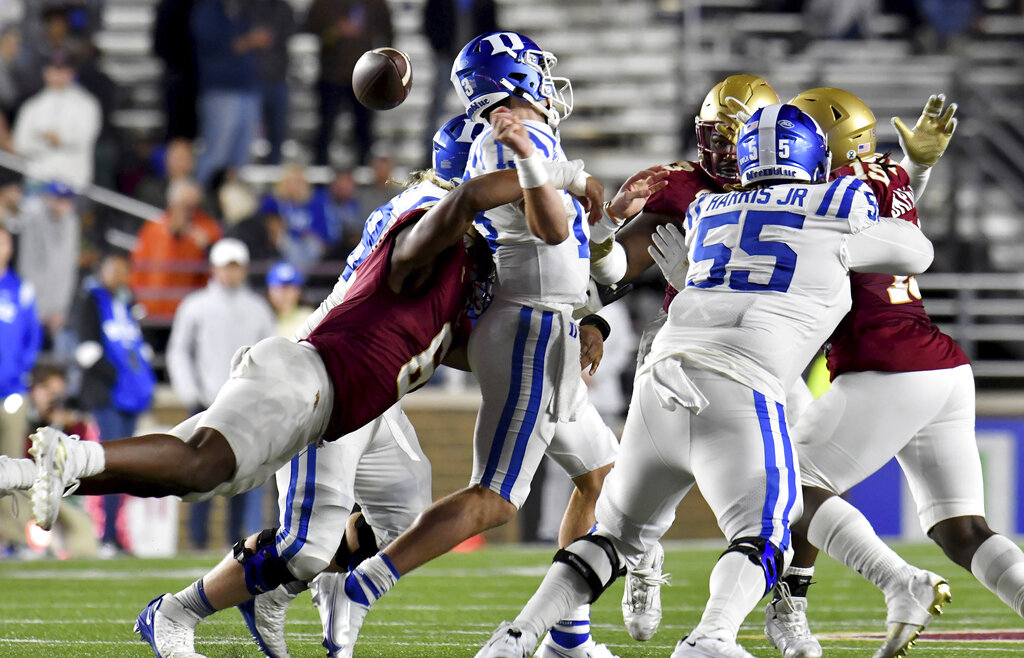
DUKE: The Blue Devils lost five games in the regular season last year — but with a 6-2 record in the ACC, they won the tie-breaker procedure over Miami (FL) to get the opportunity to face Virginia in the ACC Championship Game. Duke pulled off a 27-20 upset in that game and then ended their season with a 42-39 victory against Arizona State in the Sun Bowl. With a 9-5 record, the Blue Devils have won at least eight games in four straight seasons — and their 35-18 mark during that span represents the best four-year record in program history. But Duke may have been fortunate to register nine wins when considering that they got outgained in ACC play by -19 net Yards-Per-Game. They benefited from a +10 net turnover margin for the season, tied for the tenth-best mark in the FBS. The Blue Devils had to score outscore teams last year in high-scoring affairs since their defense surrendered 424.2 total Yards-Per-Game which resulted in 29.4 Points-Per-Game, ranking 119th and 98th in the nation, respectively. Duke only held two opponents to less than 20 points. They only return five of the 14 the top 14 tacklers from that side of the ball. Three starters are back in the secondary — and head coach Manny Diaz added four defensive backs from the transfer portal. Diaz is counting on player development for the rest of the unit after six sophomores and juniors got at least 100 snaps in the front seven last season. The plan on offense got derailed on the last day that the window of the transfer portal was open. Quarterback Darian Mensah and his favorite target, wide receiver Copper Barkate, both bolted south to play for their ACC rivals, Miami (FL). Diaz adapted on the fly, luring San Jose State quarterback Walker Eget to join the program before the portal closed. Eget was available because he is recovering from an ACL injury that kept him limited in spring practice. He threw for 3051 yards last season but completed only 59% of his passes. The offense is likely to take a step back this season. But discounting the Blue Devils has been bad business the last three seasons, despite them getting outgained in yardage in ACC play each of those years.
EAST CAROLINA: When Blake Harrell took over as interim head coach after a loss at Army midway through the 2024 season, the Pirates had lost 14 of their 19 games. Since then, Harrell has led East Carolina to 14 victories in their next 19 contests — including two straight victories in the Military Bowl against Power Four conference opponents NC State and then Pittsburgh last December. Harrell has done a really nice job of establishing a sense of culture that was missing under previous head coach Mike Houston. But the challenge remains stark as the Pirates were raided in the transfer portal with ten players leaving for Power Four conference programs, including starting quarterback Katin Houser to Illinois and two All-American Athletic Conference offensive linemen. Only three starters return from last year’s 9-4 squad. To his credit, Harrell fought back by aggressively restocking the roster with a transfer portal strategy that focused primarily on picking off good players from fellow mid-major programs — but he did add two intriguing talents at quarterback from Power Four conference teams. Harrell was previously the defensive coordinator for the Pirates for five seasons before his first full season as head coach last year. East Carolina’s defense was outstanding last season by holding their opponents to 20.1 Points-Per-Game, ranking 25th in the FBS. That unit held their opponents to just 120.3 rushing YPG, ranking 26th in the nation. The Pirates defense also ranked top ten in the FBS in Red Zone Defense and Third Down Defense — and they ranked fourth in the nation by averaging 7.8 Tackles for Loss per game. Harrell has done a great job — and his defense should remain good. But it is difficult to expect mid-majors to simply reload when the player turnover is so vast as what this program has experienced.
HOUSTON: Cougars’ head coach Willie Fritz is simply one of the best in the business — and he has been a winner everywhere he goes. He won two junior college national championships before moving to Sam Houston, where he reached the FCS championship game twice. He had immediate success at Georgia Southern before turning Tulane into a mid-major powerhouse. Now, after a 4-8 record in his first year at Houston, Fritz led them to a 10-3 campaign that culminated in a 38-35 victory against a (depleted) LSU squad in the Texas Bowl. The Cougars are now legitimate Big 12 title and college football playoff contenders. For starters, Fritz continues to consistently win in the transfer portal. He added 17 players in the offseason, including eight players named to their all-conference teams. Prioritizing past experience, the 17 players added to the program have combined to play over 14,000 snaps in their collegiate careers. The offensive line should be particularly stout with two returning starters being joined by three all-conference players in the transfer portal who collectively gave up only four sacks in their combined 1277 pass blocking snaps played. Fritz reunited with running back Mark Hughes in the portal as well after he rushed for 2779 yards and 22 touchdowns in two seasons with him at Tulane before not getting playing time last season at Oregon. The Houston offense is in very good hands with senior quarterback Conner Weigman. The former five-star recruit for Texas passed for 2705 yards last season with 25 touchdown passes and nine interceptions — and he added another 795 non-sack rushing yards. He brings moxie and leadership to the position — and this is the first time he will be playing for the same offensive coordinator for two straight seasons. The offense improved last year after bringing in Slade Nagle, who was a long-time assistant for Fritz at Tulane and the Green Wave’s offensive coordinator in 2023. After scoring only 14.0 Points-Per-Game in Fritz’s first year with the Cougars, that production doubled, with Houston averaging 29.1 PPG last season. The defense remained steady last year after losing defensive coordinator Shiel Wood to Texas Tech. Under first-year defensive coordinator Austin Armstrong, Tulane held their opponents to 22.8 PPG, which was a slight improvement over the 22.9 PPG they gave up under Wood in 2024. The Cougars are an experienced squad with 11 homegrown returning starters and another eight experienced starters in the transfer portal likely to take starting jobs for this team. If there are some red flags from last season, one is that they only outgained their Big 12 opponents by +21 net Yards-Per-Game, despite a 6-3 record in conference play. Houston benefited from +4 net close victories in games decided by eight points or less.
INDIANA: There should be no debate regarding how good a football coach Curt Cignetti is. Inheriting a program that had gone 9-27 in its previous three seasons, Cignetti flipped the switch with a 27-2 mark after last year’s perfect 16-0 record and national championship. The Hoosiers blew out Alabama by 35 points and then Oregon by 34 points in the playoffs before beating Miami (FL) in the national championship game. Cignetti is the only college football head coach to successfully navigate the first round bye since the playoffs were expanded to 12 teams. Now with the resources akin to a blue-blood program, with the university fully committed to the football program, Indiana should continue to be serious national championship contenders. Cignetti and his coaching staff may simply be the best in the country at both identifying and then developing talent. Cignetti is validating the approach to privilege production over potential in the transfer portal. Ten starters are back from last year’s team — and Cignetti brought in 17 players in the transfer portal to complement the returning production. Given the experience coming in from the portal, the Hoosiers should have 17 players with full-time starting experience in their starting lineup to open the season. Somehow, Cignetti’s coaching staff has yet to be raided by aspiring programs as he was able to retain nine of his ten assistant coaches from last season, including offensive coordinator Mike Shanahan and defensive coordinator Bryant Haines, who were both holdovers from his previous tenure at James Madison. If there are concerns, it starts with the loss of 23 graduating seniors and two other players who left early for the NFL. Indiana lost seven players who got drafted into the NFL — but filling those holes is where Cignetti focused his energies in the transfer portal. Both sides of the line of scrimmage appear strong. But can Cignetti’s teams continue to dominate the turnover battle? In his tenure with the Hoosiers, his teams have committed only 17 turnovers, the lowest number in the FBS in the last two seasons. They led the nation with a +21 net turnover margin. Certainly, much of this success comes from the coaching staff — but some of that is good old-fashioned good fortune — and the Regression Gods can be fickle. The keys of the offense are being given to senior quarterback Josh Hoover, who has thrown for 9629 yards and 71 touchdowns in the previous three seasons. On paper, his resume is more impressive than what Fernando Mendoza had before playing his first game for the Hoosiers last season. But Hoover committed 15 turnovers last season, including 13 interceptions — and he has turned the ball over 33 times in his 36 games in his collegiate career. Perhaps Cignetti will coach that out of him — but relying on three straight starting quarterbacks from the portal is precarious. But Cignetti has proven himself the pre-eminent culture-builder in college football — so he deserves the benefit of the doubt.
OREGON: For the third straight season, the Ducks' only losses last season were against the team that reached the national championship. Oregon lost to Indiana in their regular season showdown and then got pummeled in the rematch in the semifinals of the college football playoffs by a 56-22 score in a mistake-filled contest. In 2023, their only two losses were against Washington, which went on to lose to Michigan in the national championship game. In 2024, their only loss was a 41-21 loss against Ohio State in the quarterfinals of the college football playoffs. On the one hand, it is a testament to fifth-year head coach Dan Lanning that his football team’s only three losses in the last two seasons were to the eventual national champion. But on the other hand, there has to be concern that perhaps his teams are simply hitting their head on the ceiling of their potential year after year. While the Ducks have a 25-1 record in their last 26 games played from August to December, they are 1-2 in January — and those two losses were by an average of 27 Points-Per-Game. In the last three seasons, they have a 1-5 record against teams that played in the national championship game — and a 37-0 record against everyone else. There is reason to believe this is not simply a function of bad luck. Here is what I wrote in my deep dive on this team last season: “his (Lanning) game management in big moments has been questionable in my mind — and, yo, is this dude wound up tight. He has done a great job of assembling an uber-talented roster. He is recruiting as well as anyone in the country — and he has made Oregon a premier landing spot for high-level transfers without losing players of his own. Yet my concern with him is similar to the one I have about Detroit Lions head coach Dan Campbell. When there are so many good players, the head coach’s job becomes putting the players in the best position to succeed. It’s not the time to start splitting face cards just because the dealer shows a six.” A year later, it certainly seemed like his players were tight in the rematch against Indiana as they made multiple mistakes deep in their end of the field that gave short fields to the Hoosiers. One of Lanning’s assistant coaches has since been quoted: “It’s always fourth-and-one around here.” That certainly is likely to remain the case this season given the sky-high expectations on this program. With 14 starters back from last year’s squad, including many who bypassed a likely very high selection in the NFL draft, it is national championship or bust for this program (akin to what Penn State encountered last season, and it did not turn out well). The defense should be fantastic, with perhaps the best defensive line in the country and an experienced and deep group in the secondary. The one benefit of the injury bug hitting the wide receiver room last year is that the group is loaded this season. Sophomore running backs Jordan Davison and Dierre Hill, Jr. formed a great one-two punch (when healthy) last season — they combined for 1323 rushing yards and 20 touchdowns. Junior quarterback Dante Moore did not listen to the siren of the NFL to come back to lead the offense. He might have been the number one pick in the draft if he made himself available. He threw for 3565 yards with 30 touchdowns last year. But he still has room to grow when it comes to pre-snap reads. He has also not played well on the biggest of stages — and his efficiency drops significantly under pass pressure. Four of his 11 turnovers last year came in the two games against Indiana, as did nine of 19 sacks. Another concern in getting over the final hurdle is their offensive line, which must replace three starters from last season. In their last two losses in the college football playoffs, their offensive line got overwhelmed (which only exacerbated the issues for Moore last year). Lanning is doing a great job in recruiting and overseeing the development of talent before targeting good players in the transfer portal to fill potential holes. But with the loss of offensive coordinator Will Stein and defensive coordinator Tosh Lupoi, who both took Power Four conference head coaching jobs, another concern is the potential brain drain taking place on the coaching staff. The chemistry and continuity questions should be answered well since Lanning promoted from within for both positions. But it was Stein and Lupoi who played integral roles during Lanning’s tenure in Eugene.
PENN STATE: The Nittany Lions were a trendy national champion pick in many circles last season as they resembled the profile of the Michigan and Ohio State teams that won the last two national titles by returning veteran squads loaded with talent that bypassed the NFL to come back to school because of unfinished business. Penn State might have the best backfield in the nation with senior quarterback Drew Allar, along with running backs Nick Singleton and Kaytron Allen. Four starters return on the offensive line. The defense has returning stars at all three levels — and head coach James Franklin pulled off a coup after defensive coordinator Tom Allen defected to Clemson by poaching Ohio State’s defensive coordinator Jim Knowles. Things were on track after a 3-0 start to the season. But then they lost at home in double-overtime against Oregon in what felt like a statement game. They then traveled on the road to a reeling UCLA team that had fired their head coach and somehow got upset by a 42-37 score despite being a 24-point road favorite. When, the next Saturday, Penn State then got upset at home against Northwestern by a 22-21 score as a 21-point favorite, it was clear that Franklin had lost the locker room and he was fired. Frankly, I was not terribly surprised that the Nittany Lions folded under the pressure of high expectations. There were plenty of red flags for those taking the time to investigate. The defense lost four players to the NFL, including their outstanding pass rusher, Abdul Carter, who was the third pick in the NFL draft. Only eight of the 17 players who logged in 300 or more snaps last year were back. Depth concerns existed at defensive tackle and linebacker. That unit surrendered 45 points against Oregon in the Big Ten championship game after letting USC score 30 points against them earlier in the season — and Notre Dame scored 27 points in their three-point loss to the Fighting Irish in the college football semifinals. In their three losses two years, the Nittany Lions got only eight combined catches from their wide receivers. Franklin tried to finally address that deficiency in the transfer portal — but he failed to provide adequate help to Allar, who lost his favorite target, tight end Tyler Warren. I always considered Allar a bit overrated relative to the Heisman Trophy and “first quarterback off the board” in the NFL draft hype. Allar completed 73.7% of his passes two years ago — but that mark dropped to just 60% in the playoffs. Did these folks propping him in the offseason even watch the college football semifinals game against Notre Dame? Penn State’s potential game-winning drive late in that game ended in an interception. Allar also struggled in a 20-13 loss against Ohio State. What was the Nittany Lions’ best victory two years ago? Boise State? SMU? Illinois? The Nittany Lions remain a program that is winless against Michigan and the Buckeyes in their last eight contests against them in the last four seasons. I had it right when I wrote in my deep dive on this team last year: “Penn State under Franklin’s leadership may simply be flat-track bullies. In the last three seasons, the Nittany Lions have a 34-2 straight-up record when favored — and they are 27-0 straight-up when favored by six or more points in those games. But in their six games as an underdog during that span, they have failed to pull off even one upset.” After last year’s 7-6 campaign that ended in the Pinstripe Bowl against similarly overhyped Clemson (proving our divine maker does have a sense of humor) with a 22-10 victory as a 2-point underdog, the Nittany Lions finally ended what was an eight-game losing streak as an underdog — but their other six wins were in games where they were favored by at least a touchdown. Say what you want about Franklin (especially in big games), but few can with his recruiting — and that was the basis for the biggest criticism. Despite all the talent he assembled, he could rarely win a big game, especially against Power Four competition (Penn State’s quarterfinal win in the 2024 College Football Playoff was against Boise State). But now 42 players left in the portal after the season ended. The administration turned to Matt Campbell as its new head coach after a very nice ten-year run at Iowa State. A perennial doormat, Campbell turned the Cyclones into a very respectable program. Yet perspective is needed. His Iowa State teams finished in the top 15 polls at the end of the season only twice in his ten seasons. Similar results in Happy Valley will get him fired in three years — and while his talent base should be better, his competition is much steeper when now facing Big Ten opponents with huge budgets and raised expectations about playing defense (as opposed to the Big 12). Campbell did what he had to do — so he convinced 24 of his players at Iowa State to join him in the move, with 11 to 13 likely to be starters. In all, about 40 new players from about 20 different programs were brought to replace the 70 players from last year’s Nittany Lions team that had national championship aspirations. A plethora of injuries during spring practice did not help the cause of establishing chemistry and a new culture. I understand the need for some sense of continuity — but if Penn State is going to be Iowa State East this season, let’s remember that the Cyclones went only 5-4 against inferior Big 12 competition last year. Senior Rocco Becht, a three-year starter at Iowa State, brings veteran leadership and experience — and his top four targets in the passing game and running back Carson Hansen joined him in the move to Happy Valley. But the Iowa State offense ranked only 63rd in SP+ using the efficiency metrics of ESPN’s Bill Connelly. I like the hire of defensive coordinator D’Anton Lynn, who was intrigued to coach for his alma mater after two seasons running the defense at USC. But with just three starters returning, the core of the defense will be the seven former Cyclones starters coming over. Optimists are pointing to the relatively easy schedule, with Penn State avoiding Indiana, Ohio State, and Oregon in their regular-season schedule. The only “blue bloods” they face before the postseason are Michigan and USC — and they will likely be underdogs in both those games. But this program cannot simply pencil in victories against Wisconsin, Northwestern (who beat them last year), Washington, Minnesota, Rutgers, and Maryland, as all those programs have expectations of their own and are very hungry to register what would appear to be a signature victory. If Penn State was also closer in quality to the old Big Ten West competition than they were to the Big Two of Ohio State and Michigan (before the Pac-12 teams entered the conference, making the margin of error even thinner), then the transformation from Franklin’s uber-talented but underachieving rosters to Iowa State East is going to be even bumpier than expected.
KENT STATE: After two seasons under head coach Kenni Burns, during which the Golden Flashes lost 23 of their 24 games before he was unceremoniously fired for an alleged loan scandal with a booster, interim head coach Mark Carney performed a minor miracle by picking up the pieces during spring practice and leading this football team to a 5-7 record. Admittedly, we need to consider the possibility that Burns, who had previously served as the running backs coach at Minnesota, was simply a train wreck. Kent State had gone 22-21 the previous four years under head coach Sean Lewis. But considering the lack of funding for this program as the college football landscape became dependent on NIL and the transfer portal, what Carney was able to do has to be respected. Most importantly, he immediately got buy-in and got his players to compete very hard for him. That should continue. Carney also seems to have an eye for talent — and his tapping of redshirt freshman Dru DeShields as his starting quarterback was rewarded. In 11 starts last season, DeShields threw 18 touchdown passes and only three interceptions — and he demonstrates leadership qualities this team needs. He is one of six starters who return on offense. After losing all 16 of their games against Mid-American Conference competition under Burns, the Golden Flashes' 4-4 record in conference last year was a stark improvement. One could nitpick with their getting outgained by -50 net Yards-Per-Game against MAC opponents, but it is still much better than getting outgained by 283 YPG in conference play in 2024 when MAC opponents outscored them by 30 Points-Per-Game. Of course, Kent State lost players in the transfer portal — and programs like this will only go so far as what is left on both sides of the line of scrimmage. Carney is focusing on the high school ranks as he brought in 24 freshmen for this season, with 11 of them already competing in spring practice. Some harsh realities remain. Against top-50 competition using the SP+ rankings of ESPN’s Bill Connelly, the Golden Flashes were 0-4, with the average losing score being 54.3-8.5. But an overachieving roster playing hard for their inspiring head coach was enough for a 5-3 record in their other eight contests last season — and that dynamic should not be discounted.
MARSHALL: Head coach Tony Gibson did a commendable job in leading the Thundering Herd to a 5-7 record last season. After Marshall and previous head coach Charlie Huff agreed to part ways, 47 players left the program in the offseason. Gibson brought in more than 70 new players to the program in a rebuilding assignment, which is massive as it gets in college football. Yet the Thundering Herd outgained their Sun Belt conference opponents by +8 Yards-Per-Game despite a 3-5 record in conference play. Marshall could have played in a bowl game if not for their 1-4 record in games decided by one scoring possession. The roster stability is much better for Gibson’s second season with nine starters back. Gibson “only” added 26 new players in the transfer portal to complement a solid freshman class. The former North Carolina State defensive coordinator should see his defense improve this season despite losing three of his top four sack leaders in the transfer portal. The Thundering Herd surrendered 410.6 total YPG, which resulted in their opponents scoring 30.3 Points-Per-Game, ranking 106th and 107th in the nation. Gibson has his answer at quarterback with Carlos Del Rio-Wilson returning for his senior season. The former four-star recruit for Florida emerged last year by passing for over 2000 yards with 17 touchdown passes and just five interceptions. The dual-threat also added 714 non-sack rushing yards and six rushing touchdowns.
MIAMI (OH): Last season was a test to see where the floor was for the RedHawks under head coach Charlie Martin after only six starters were back from the team that reached the Mid-American Conference championship and finished with a 9-5 record. As I concluded on my deep dive for this team last season: “The RedHawks lost plenty of talent that made the All-Conference team, which may lower the ceiling regarding what this team can accomplish — but the consistency and culture that Martin has established should not be underestimated.” Sure enough, Miami (OH) finished 6-2 in conference play and reached the MAC Championship Game for the third straight season. Although they lost to Western Michigan in that game by a 23-13 score — and then got beat by Fresno State in the Arizona Bowl by an 18-3 score — it should be considered a very successful season when considering the challenges coming into the year. With Jason Candle departing Toledo, the RedHawks are the clear cream of the crop in the MAC as Martin begins his 13th year running the program. He has established a clear identity and culture that emphasizes defense, special teams, and smart play. Miami (OH) has played in three straight MAC championship games — they have a 55-20 record in conference play in their last 75 games. Now Martin has a bountiful NIL program from which to retain key players while attracting talented incoming transfers. Martin has nine returning starters plus an intriguing influx of talent from Power Four conference programs from the transfer portal.
NEBRASKA: Expectations were high in Lincoln last year in the third season under head coach Matt Rhule, who had led both Temple and then Baylor to the conference championship games with 10-4 and 11-3 campaigns in his third as the head coach at the programs. Finally getting the benefit of bowl practices was going for the first time since 2016 was also going to be a big boost heading into the fall — and things seemed to be on track when the Cornhuskers opened the season with a 6-2 record. But the wheels fell off the proverbial wagon as they lost four of their last seven games — and they were not competitive in their final three games in a 27-point loss against Penn State, a 24-point loss against Iowa, and then a 44-22 loss against Utah in the Las Vegas Bowl. A porous offensive line played a role in sophomore quarterback Dylan’s Raiola suffering a season-ending broken fibula that cost him the final four games of the season. But an inexperienced front seven that did not have a returning starter from the previous season got completely exposed in the run game. Nebraska ranked 98th in the nation by surrendering 175.4 passing Yards-Per-Game — and six of their opponents rushed for more than 200 yards against them. Big Ten opponents generated 5.0 Yards-Per-Carry against them. As has become common practice, Rhule continued the “I cannot fail, I can only be failed by my assistant coaches” mantra by firing several coaches. On defense, Rhule let defensive coordinator John Butler go after one season after promoting him from defensive backs coach when previous defensive coordinator Tony White defected for the same job at Florida State. But with the lack of depth in the front seven, who was in charge of building the roster, Mr. Rhule? On the other side of the ball, offensive line coach Donovan Raiola was let go in yet another example of failed nepotism as Dylan’s uncle was brought in to help sweeten the package that eventually persuaded the five-star quarterback to withdraw from Georgia and commit to the Cornhuskers. Now Raiola has departed the program in his transfer to Oregon — and it is a massive indictment of Rhule’s regime that Raiola deemed it preferable to back up the Ducks’ quarterback Dante Moore this season before presumably getting his chance to take the field again in 2027. Rhule turned to UNLV quarterback Anthony Colandrea in the portal — and the Mountain West Conference Offensive Player of the Year has the mobility and scrambling skills that Rhule seems to prefer. But make no mistake that it is a downgrade at quarterback from Raiola — and Colandrea’s nine career multiple interception games are a significant cause for concern. Raiola poached Georgia Tech offensive line coach Geep Wade to fix the offensive line — but losing All-American running back Emmett Johnson to the NFL does not help. Offensive coordinator Dana Holgorsen returns for his second full season after he took over on an interim basis near the end of the 2023 season when Rhule fired offensive coordinator Marcus Satterfield after nine games. Remind me, who is the one hiring these bums that are getting fired so quickly? Rhule turned to San Diego State defensive coordinator Rob Aurich, who did a nice job with the Aztecs last year — but this is just his second season as a defensive coordinator, and he will be overseeing the defense transitioning from a 3-3-5 to a 4-2-5 formation. On paper, the secondary looks great with three starters back from a unit that ranked third in the nation by holding their opponents to 154.1 passing Yards-Per-Game — but that number is somewhat skewed by their opponents being quite content to just continue running the ball against a unit that was giving up around five yards per carry. Aurich is the fourth defensive coordinator in the program’s last five seasons going back to the dysfunctional days of the Scott Frost coaching era. Rhule has certainly made Nebraska respectable again with two winning seasons in a row after enduring seven straight years under .500. Four of their victories last year were in games decided by seven points or less — a stark contrast from what was happening under Frost. But Rhule was advertised as a culture builder — and there has been little continuity on the coaching staff on both sides of the ball. The program is also becoming very dependent on the transfer portal to find starters, which is not a ringing endorsement of Rhule’s recruiting. Perhaps Rhule deserves some benefit of the doubt given the mess he inherited. On the other hand, the failure to develop Raiola and his decision to leave the program may be a canary in the coal mine when assessing what went wrong in Rhule’s tenure.
NORTH TEXAS: Before last year, the Mean Green had not had a winning season since 2018 and had lost seven straight bowl games since 2013. But North Texas defiantly ended both those droughts with a 12-2 campaign that included playing in the American Championship Game and culminating their season with a 49-47 victory against San Diego State in the New Mexico Bowl. Unfortunately for the faithful in Denton, there is very little to ruminate on that team when it comes to assessing this year’s squad. Head coach Eric Morris left for Oklahoma State after three seasons — and he took many of the Mean Green’s best players, including junior quarterback Drew Mestemaker and sophomore running back Caleb Hawkins, who were both key cogs in an offense that led the nation by scoring 45.1 Points-Per-Game and generating 512.2 total Yards-Per-Game. A vast majority of the players that Morris did take with him were quickly poached by other programs. North Texas has zero starters returning from last year’s squad — and only defensive tackle Terrell Washington, with his 330 snaps, is the only player back on the team that logged in at least 200 snaps last season. It’s as close to a complete reset as we will ever see. New head coach Neal Brown brought in more than 50 players in the transfer portal — and some of the names are intriguing. But the new players from the transfer portal only accounted for 82 combined starts last season. For context, nine of the 15 American Conference teams returned at least 78 combined starts before their transfer portal work. This Mean Green team will be very inexperienced. Brown failed to get West Virginia as their head coach recently — but in his previous stint at Troy, he led the Trojans to a 31-8 record from 2016-2018. This program always has potential given its ability to recruit local players in Texas — but it is difficult to have immediate expectations with a new coaching staff and essentially a brand new roster assembling together.
OHIO STATE: The Buckeyes were cruising right along by winning all 12 of their games in the regular season. But then they lost a nail-biter in the Big Ten Championship Game to Indiana by a 13-10 score. And then in the quarterfinals of the College Football Playoffs, they trailed Miami (FL) by a 14-0 score at halftime and could not do enough to rally in a 24-14 setback that ended their season. In hindsight, only losing to the two teams that eventually reached the national title game is no crime. Assuming a seamless reload from a national championship squad after then losing 15 players to the NFL is tough for any team to overcome. But expectations are as high as they get in Columbus, especially after a perfect regular season. I understand head coach Ryan Day wanting to lean on his defense and play conservatively with a freshman as his new starting quarterback. Ohio State played at the slowest pace in the nation when on offense. And Julian Sayin’s 77% completion percentage was the third best in FBS history for a starting quarterback. He threw for 3610 yards with 32 touchdown passes and eight interceptions. But, in hindsight, Day should have probably shifted gears and taken the training wheels off the offense in the postseason — especially when he could lean on his elite defense to bail them out if mistakes were made on offense. The Buckeyes scored only 24 combined points against the Hoosiers and Hurricanes — and they left too many points on the field. Day settled for a game-tying field goal on fourth-and-one from Indiana’s nine-yard line late in the Big Ten Championship Game — and while I am not a fan of aggressive fourth-down play-calling when chip-shot field goals can tie the game, the underlying reality was that Ohio State was destined for a bye in the first round of the playoffs regardless. Going for the victory in those circumstances may have better served the team in the long run to build confidence on that side of the ball in the playoffs. Instead, the 26-yard field goal attempt was missed. Then in the second half against Miami (FL), they continued to play at a slow tempo as they embarked on their comeback. With the Hurricanes happily engaging in slowing the game down when they had the football, the Buckeyes only got three legitimate second half possessions — and on one of them, they squandered four minutes in a seven-play drive that ended with a punt. I applaud Day delegating the play-calling duties on offense to his offensive coordinator so that he can better attend to game management. But he’s got to manage the damn games better. Ohio State had the best defense in the country last season — they limited their opponents to just 219.1 total Yards-Per-Game which resulted in a mere 9.3 Points-Per-Game, both the best marks in the nation. It was 2011 when the last time an FBS team gave up fewer points. That is exactly the defense that should have been trusted to bail out an offense getting aggressive in the second half after failing to score in the first half. The Buckeyes should have gone no-huddle in the second half of that game — is there any doubt that is what Nick Saban would have done? The hope is that Sayin will benefit from the learning experiences from those two losses — and he will be asked to move the ball this legs more often in his sophomore season. But he needs to be given more trust to make plays — and get the ball into their embarrassment of riches of their playmakers, headlined by junior wide receiver Jeremiah Smith. Former Pittsburgh Steelers offensive coordinator and Atlanta Falcons head coach Arthur Smith is their new offensive coordinator after Mile Hartline got the South Florida head coaching job. He is the third former NFL head coach that Day has tapped as an offensive or defensive coordinator — and I’m not sure that formula is a guarantee for success at the college level. There is a solid argument to be had as well that Smith’s only successful seasons calling the plays on offense were when handing the ball off to Derrick Henry was the primary option. On the other side of the ball, I have to concede just how well Matt Patricia was in communicating and teaching to his group. Patricia deployed a simple scheme — but his players were very well prepared for their opponent, and the simplicity helped them play fast. It was a very good fit, matching the Buckeyes superior talent with Patricia’s knowledge of the game. But the loss of talent cannot be overlooked. Ohio State lost seven of the nine players who started all 14 games last season. All seven of those players got drafted into the NFL, including five in the first two rounds of the NFL draft and three in the top 11 picks in the first round. It’s impossible to simply reload from all that attrition. The Buckeyes defense should remain at least very good — but regression has to be expected. Usually, Day would rely on his recruiting and his coaches' player development to fill these holes -- but he pivoted. The 18 players he brought in via the transfer portal are the highest in program history — and from the freshman class and walk-ons, there are more than 50 new players on this season’s roster. Granted, more than 30 players left the program in the transfer portal — so there was a need to bring in players. But I strongly suspect most of these reserve players leaving were because they did not expect to see significant playing time — and Day’s new emphasis on the portal plays a direct role in that. Certainly there have been programs that found success poaching talent at the highest level to reload their roster. But all those programs had the talent base of the average Ohio State squad. The increased reliance on the transfer portal risks disrupting the culture Day has enabled in Columbus in two ways. First, all the new players are unknowns — and the more there are, the more they could disrupt the tone and atmosphere established by the veterans. Second, the homegrown players can quickly become disgruntled if they lose their expected spots on the depth chart to newcomers who did not do their time establishing themselves in the culture. In the height of Day’s struggles in the Buckeyes’ rivalry with Michigan with Jim Harbaugh at the helm, the biggest criticism of Day was his lack of courage of conviction. He looked tight in the "Big One" against Harbaugh; he would call the game tight — and it made his team play tight against the Wolverines. I understand the temptation to dangle the Ohio State brand name and deploy what is perhaps the best NIL program in college football to bring in a bunch of shiny new objects. But perhaps that was an overreaction to losing the final two games of the season. In defending his increased reliance on the transfer portal, Day compared the new college football landscape to the time of the dinosaurs: “We’re going to adapt. We’re not going to die.” But when the rest of the college football world considers Ohio State the equivalent of Tyrannosaurus Rex, then “adapting” may actually be blinking. Day’s immediate comment before that quote was: “We’re not allowed to lose a game.” Two final comments on that. First, that belief explains his risk-averse game management that too often can be described as “playing not to lose.” Ask professional poker players how successful that mentality is. Second, the Buckeyes can certainly lose games — they lost to both Michigan and Oregon in their championship run two years ago. In fact, Ohio State is one of the few programs — like Alabama — that could still make a 12-team playoff after losing three times. The Buckeyes just can’t lose in the playoffs — the reality of every team that plays in the NFL. Ohio State will be better served if — and when — their head coach realizes that success in the era of college football is defined by winning in the playoffs. Everything else is either qualifying for those playoffs or preparing your squad for that single-elimination tournament.
OREGON STATE: On paper, the Beavers were 2-10 last season. But they only got outgained by -30 net Yards-Per-Game, which is in the general range for a team with a 4-8 or 5-7 record. They lost their first six games of the season — but they were literally three plays away from a 3-3 mark. After dropping their seventh game in a row — all against teams that would later play in bowl games — the administration fired second-year head coach Trent Bray. Under interim head coach and former Central Michigan defensive coordinator Robb Akey, Oregon State won their next two games before stumbling down the stretch by losing their final three games. The program now turns to rookie head coach JeMarcus Shephard to steward the team in the reimagined Pac-12 conference. Shephard is a Kalen DeBoer protege who was the passing game coordinator and wide receivers coach for their 2022-23 team that reached the national championship game before following DeBoer to Alabama, where he was the co-offensive coordinator, assistant head coach, and wide receivers coach the last two seasons. Ten starters are back from that team, and Shephard was active in the transfer portal by bringing in former blue chippers in need of a second chance as well as potential diamonds in the rough at the FCS level. Former Duke quarterback Maalik Murphy returns under center — it is the first time that the Beavers have their starting quarterback return for a second straight season since 2019. But it is hard to win in Corvallis — and the near destruction of the Pac-12 did them no favors as a de facto independent along with Washington State the last two years. Losing players in the transfer portal to the power conference sharks is expected for second-tier programs like this — but it is an ominous sign when they are now losing players to comparable programs. Shephard is a player’s coach — but he is the fourth head coach in four years for this program when including the interim head coaches. Only when that cycle ends can Oregon State begin to rebuild its culture post the Jonathan Smith era. This is a football team that begins the 2026 season having lost 16 of their last 19 games.
PITTSBURGH: The Panthers started the season 2-2 — but when head coach Pat Narduzzi then handed the keys to the offense to freshman quarterback Mason Heintschel, the offense took off. Heintschel would lead the team to six wins in his nine starts while completing more than 63% of his passes for 2354 yards. He threw 16 touchdown passes but will want to lower the eight interceptions he threw last season. Freshman running back Ja’Kyrian Turner emerged in the final five games as well by rushing for 745 yards on a 5.3 Yards-Per-Carry average with seven touchdowns — and he ran for 201 yards against Georgia Tech. In the second season under offensive coordinator Kade Bell’s up-tempo spread, Pittsburgh ranked 20th in the nation by generating 33.7 Points-Per-Game. That said, in a final regular-season showdown with Miami (FL) where a victory would have placed them in the ACC Championship Game, they got thumped by a 35-7 score. They then lost to East Carolina in the Military Bowl by a 23-17 score. The 19-year-old Heinstschel will need to demonstrate he learned from those late-season loss — and he particularly struggled when under pressure. He needs more help from his running backs after the Panthers ranked 88th in Rush Success Rate and ranked just 115th in the FBS by averaging 117.2 rushing YPG. The development of the now-sophomore Turner late in the season is encouraging — and Narduzzi brought in Western Kentucky senior running back La’Vell Wright for depth. The offensive line could be a strength with four returning starters along with five of the top seven backs from last year’s depth chart — and Narduzzi poached Akron All-Mid American lineman Keylon Davis to help fortify the line. The defense was outstanding last season, limiting their opponents to 330.4 total Yards-Per-Game, ranking 32nd in the nation. The Pitt run defense was particularly stout as they limited their opponents to just 3.6 (non-sack) Yards-Per-Carry — and they ranked fourth in the FBS with Stuff Rate at or behind the line of scrimmage in 25.8% of their opponents’ rush attempts. Overall, the Panthers ranked eighth in the nation by limiting their opponents to 95.1 rushing YPG. As expected, defensive coordinator Randy Bates retired after eight seasons in that position — but the continuity should be fine with Cory Sanders taking over after serving as the defensive backs coach since 2018.
SOUTH CAROLINA: After a 9-4 campaign last year, the Gamecocks entered last season as a legitimate playoff contender with a potential number one pick in the NFL draft at quarterback. With his cannon of an arm, a 6’3 and 240-lb frame, and dual-threat rushing skills, LaNorris Sellers had huge expectations last season. But the offensive line was a mess after needing to replace the interior three starters — and the injury bug exposed a lack of depth at the position. Head coach Shane Beamer continued his disturbing trend of firing his assistants as he fired offensive line coach Lonnie Teasely in early October — and he later fired first-year offensive coordinator Mike Shula on November 2nd. Well, who is hiring these bums? The South Carolina offense played better in the final month of the season — and they scored 30 points against Texas A&M — but they still stumbled to a 4-8 record and missed out on a bowl bid. The Gamecocks posted a 1-7 record in the SEC — and they got outgained by -68 net Yards-Per-Game against conference opponents. Beamer now turns to his fourth offensive coordinator in the last five seasons by poaching TCU offensive coordinator Kendal Briles. To address the offensive line, Beamer hired Randy Clements as the new position coach. The 35-year-old veteran comes over with Briles from TCU. Beamer also brought in eight offensive linemen in the transfer portal, including six seniors and five previous starters from FBS programs. The defense lost three players in the NFL draft, but four of the top five tacklers return from last year’s unit. South Carolina has been wildly inconsistent in Beamer’s first five years running the program. But NFL talent exists on the roster — and if Sellers, along with junior defensive end Dylan Stewart, perform as future first-round NFL picks, then, sure, this is a potential playoff team.
TEXAS STATE: The Bobcats completed their third winning season in the three years under head coach G.J. Kinne with a 41-10 victory against Rice in the Armed Forces Bowl to finish with a 7-6 record. But it should have been better. They settled for a 3-5 record in Sun Belt Conference play despite outgaining their conference opponents by +85 net Yards-Per-Game. Their season got defined by a five-game losing streak midseason where they were seemingly cursed in four of those games. They lost by one point at Arkansas State despite outgaining the Red Wolves by a 521-398 margin — and it was a missed extra point followed by a last-second touchdown allowed that cost them that game. Against Troy, they lost in overtime after blowing a 21-point lead and then missing a potential game-winning field goal — despite outgaining the Trojans by a 574-458 margin in yards. They lost in double overtime against Marshall after giving up a last-minute touchdown in regulation — despite outgaining them by a 558-466 yardage margin. In a three-point loss to UL-Lafayette, they outgained the Ragin’ Cajuns by a 528-384 margin but failed on multiple two-point conversion attempts. Clearly, the defense is too often letting them down in these blown leads. Texas State surrendered 29.0 Points-Per-Game last year, ranking 94th in the nation. Kinne addressed that problem by tapping South Alabama defensive coordinator Will Windham to take over that unit. Four returning starters are back — but improvement on that side of the ball will probably depend on the impact of several transfers on the defensive line. Kinne does know offense. His “shred-and-spread” offense ranked fifth in the nation for the second season in a row by generating 472.8 total Yards-Per-Game. The Bobcats have scored 36.5 PPG in his tenure. Seven starters return, headlined by quarterback Brad Jackson. The redshirt sophomore completed 71.3% of his passes for 3224 yards with 21 touchdown passes and seven interceptions — and he added another 890 non-sack rushing yards and 17 touchdowns with his legs. His top four targets in the passing game return, including Beau Sparks and Chris Dawn Jr., who both registered 1200 and 1007 receiving yards a year ago. Texas State moves to the revamped Pac-12 this season. The offense should still be prolific against Oregon State, Washington State, and the programs that left the Mountain West Conference. Kinne’s up-tempo offense would better serve the team if it could be more effective in operating a four-minute offense to protect leads late in the game; it is too simplistic an answer to suggest it was only their defense at fault in all those blown leads last season.
TULANE: The Green Wave won the American Conference championship game in a 34-21 victory against North Texas last season — and that was enough for them to qualify for their first-ever college football playoff game. They have a 43-13 record in the last four seasons after last year’s 11-3 mark, while reaching the conference championship in four straight seasons. The elevation of this program to an elite Group of Five/Six program has been on the backs of two outstanding head coaches: Willie Fritz and then Jon Sumrall. But now Fritz is the head coach at Houston, and Sumrall took the open head coaching job at Florida. It remains unknown whether this program can continue to simply restock their coaching staff and expect similar results of this decade. The administration privileged culture and continuity by elevating offensive passing game coordinator Will Hall as their next head coach. Hall had served as the offensive coordinator for this team in the 2019 and 2020 seasons before returning to the program last year — so he has coached under both Fritz and Sumrall. He left the team to take the head coaching job at Southern Mississippi from 2021-2024 — and critics will point to his underwhelming 14-30 record during that span before he was fired. But Hall did have plenty of success at the Division II level as a head coach last decade before Fritz hired him to run the Tulane offense. Regardless of the head coaching situation, there were always going to be some other red flags heading into this season. The Green Wave won all five of their games decided by one scoring possession — and their +5 net close win margin was the highest in the FBS. After their 41-10 loss at Ole Miss in the first round of the College Football Playoff, their three losses were by a combined 88 points. And let’s not forget that their quarterback situation was very sketchy before they got bailed out when BYU’s Jake Retzlaff got suspended by the Cougars when he admitted he violated school policy by engaging in some premarital extracurricular activities — his late entry into the transfer portal may have bailed out Tulane’s season. Retzlaff is now gone, testing the waters at the professional level after not getting drafted in the April NFL draft. The Green Wave’s quarterback room is once again a big question mark. Former Ball State quarterback Kadin Semonza is back after being the third stringer last year. Hall tapped former Houston starting quarterback Zeon Chriss-Gremillion in the portal after he lost his starting job to Conner Weigman last year. The dual-threat quarterback has speed to burn with his legs — but he struggled in the passing game as the Cougars' starting quarterback in 2024. Both sides of the line of scrimmage are concerns this season. Three players with starting experience are back on offense — and Hall brought in three transfers to add depth. The defensive line lost all three of their starters — and five players left in the transfer portal to Power Four conference opponents — but this was a unit with depth last year. The defense returns six of their top ten tacklers. The Green Wave has a solid NIL program that helps them fend off lower-level Power Four conference programs — but they are likely always going to be fodder for the elite teams in the FBS. The question now is whether Hall can keep them at the top level in the American Conference.
Best of luck — Frank.
To help document this work while crystallizing my thoughts for each team, I am providing a summary of each team highlighted by a critical question that will go a long way in their success or failure.
ALABAMA: After missing the playoffs in head coach Kalen Deboer’s first season running the program, the Crimson Tide made the playoffs as a bubble team last year — and they then beat Oklahoma on the road in the first round. But Alabama was simply outclassed in the quarterfinals at Indiana by a 38-3 score — and that continued a disturbing trend that rarely happened in the Nick Saban era. The Crimson Tide also got spanked in the SEC Championship Game against Georgia by a 28-7 score. After losing to Oklahoma by a 24-3 score in DeBoer’s first year in Tuscaloosa and opening last season with a 31-17 loss against Florida State, Alabama has already racked up four losses by double digits since DeBoer took over. There are significant concerns on both sides of the line of scrimmage. After losing four of his top five defensive linemen either to the NFL or the transfer portal, DeBoer had to rely on the portal to bring in his likely starting three in defensive coordinator Kane Wommack’s 3-3-5 scheme. At least that could address the size problem as Alabama got pushed around by the Bulldogs and Hoosiers in those late-season losses. The offensive line lost six of their top seven on the depth chart last year. DeBoer brought in six transfers, but only two were starters from FBS programs. Depth at the line of scrimmage was simply never an issue under Saban. Perhaps this is simply the fallout from losing more than 30 players in the portal after Saban's surprise retirement two years ago? On paper, DeBoer is recruiting well — but the state of the offensive and defensive line has been the biggest decline in excellence in the post-Saban era. This has manifested itself in a dreadful running game under DeBoer. The Crimson Tide’s 4.4 Yards-Per-Carry average from running backs in the last two seasons is the eighth lowest of all Power Conference programs. Their 3.4 Yards-Per-Carry team mark last year was the third-worst for this program since 1970. They ranked 123rd in the nation by generating only 104.1 rushing Yards-Per-Game last season. In their losses to Georgia and Indiana, they rushed for a mere 20 combined yards. There is blue-chip talent in the running back room, but perhaps the offensive line is simply the Achilles heel to get the ground game going. This failure to run the ball effectively may also be endemic to executing Air Raid concepts against top-level defenses with elite size on the defensive line like many of the programs in the SEC and Big Ten — there is a reason why the Air Raid is not a popular scheme in either power conference. I’m not in love with offensive coordinator Ryan Grubb as a play-caller, either. Three of the top four targets in the passing game are gone. Junior Ryan Coleman-Williams is still around — but he led all high-targeted wide receivers last year with a drop rate of 13.0% of the passes directed at him (but perhaps adding the “Coleman” to his last name will solve his dropsies problem?). Only six players remain on the roster from the Saban era. This is DeBoer’s team — and it looks as if he is giving the keys to the offense to five-star redshirt freshman Keelon Russell after he starred in spring practice. The talent remains mostly elite. But perhaps expecting the uber-high standards established in Saban’s tenure was simply too much to ask.
AUBURN: For the fifth straight season, the Tigers suffered a losing season as they settled for a 5-7 record last year. Third-year head coach Hugh Freeze was fired on November 2nd. The biggest problem is this football team’s inability to win close games. Auburn lost all six of their games decided by one scoring possession last year — and they have now lost 12 of their last 13 contests decided by eight points or less. While they finished only 1-7 against SEC opponents, they were only outgained by -7.0 net Yards-Per-Game. In their 2-6 conference campaign two years ago, they outgained their SEC rivals by +62 net YPG. It’s fair to conclude the fundamental problem was a losing culture under Freeze after his last tenure in the SEC with Ole Miss ended in less-than-endearing results. In comes South Florida head coach Alex Goresh for the last three seasons. After inheriting a Bulls squad that had lost 49 of their last 53 games, they went 23-16 in his three-year tenure. As is the tactic, Goresh brought in 11 key players from the Bulls to meld with this Tigers team that returns only four starters. The key player is senior quarterback Byrun Brown. The dual-threat quarterback passed for 3158 yards last season and added 1121 non-sack rushing yards — and he accounted for 42 touchdowns with his arm and his legs. Three of his targets in the passing game came over in the portal. The Tigers have finished outside the top 50 in scoring and outside the top 50 in ESPN’s Bill Connelly SP+ top 40 rankings since 2019. Perhaps continuity on offense from all these South Florida players and their offensive coordinator Joel Gordon for the last three seasons will give that side of the ball the spark it needs. The defense is in pretty good shape — and Golesh was smart to retain defensive coordinator D.J. Durkin for his third year running that side of the ball. Auburn has ranked in the top 20 in the SP+ defensive rankings in two straight seasons. They do have to replace defensive ends Kendric Faulk and Keyron Crawford, who got drafted in the first and third rounds of the NFL draft. Durkin lost six of his top eight tacklers and eight of the ten players who logged in at least 300 snaps. But if Golesh can bring juice and confidence on his side of the ball, the ceiling becomes much higher for this program if they can start winning more of these close games.
BALL STATE: It took first-year head coach Mike Uremovich only nine games to reach four wins and match the team’s season high in the previous two seasons. The administration appears to have made a good hire after he turned a struggling FCS Butler program around with a 23-11 record in his three seasons. The former Temple and Northern Illinois offensive coordinator is a familiar face for high school coaches in Indiana. But the Cardinals lost their final three games by an average of -21.6 Points-Per-Game to end the season with a 4-8 mark. Talent is the biggest obstacle to turning around this program that has not had a winning record since the 2020 COVID-impacted season. That was Ball State’s only winning season since 2014. Despite a 3-5 record in conference play, the Cardinals got outgained by -122 YPG against fellow Mid-American Conference opponents. On the road, they got outgained by -195 YPG, with their average losing score being 36-10. Only seven starters return, but Uremovich was active in the transfer portal, bringing in 25 new players either looking for playing time from other FBS programs or looking to succeed at the FBS level after competing for FCS or Division II football teams.
BAYLOR: Ever since the Bears won the Big 12 Championship in 2021, my seasonal deep dives into this team have included speculation regarding whether that achievement was a fluke under head coach Dave Aranda. After last season’s 5-7 campaign, Baylor has a 22-28 record with only one winning season. After missing the postseason last year, they have only played in two bowl games in the last four seasons. Frankly, Aranda probably is out of a job if not for the Baylor administration first firing athletic director Mack Rhoades late in the football season and seemingly kicking the can on the fate of their football coach until they brought in their next athletic director. If there is a head coach sitting on a hotter seat, I do not know who that is. As I seem to point out every year at this time: “Aranda’s stamp should be on the defensive side of the ball after previously serving as the defensive coordinator at LSU — and there seems to be a disconnect between his schemes with the Tigers and the game plans now with the Bears.” His defense hit rock bottom three years ago by ranking 113th and 110th by surrendering 33.3 Points-Per-Game and 421.3 total Yards-Per-Game. The “fix” two years ago was for Aranda to call the defensive plays while also coaching the linebackers. But the Baylor defense only took small steps forward by surrendering 386.2 total YPG (87th in the FBS) and ranking 63rd in ESPN’s Bill Connelly’s SP+ defensive ratings. In terms of total yardage, only one of Aranda’s defenses has ranked inside the top 48 in the nation in his five years. Last year, the Bears surrendered 392.1 total YPG, which resulted in 32.6 PPG, ranking 87th and 120th in the nation. They gave up 197.2 rushing YPG, which was the 120th worst in the nation — and there simply is not a Power Four conference opponent that can function effectively if their opponents are averaging 4.9 Yards-Per-Carry. As always for Aranda, he is making changes — and this time it will be different! He has removed himself from calling plays on defense, with this being rationalized as him now being able to help coach the coaches and better evaluate the players, as if that was not the plan in the first four years of his tenure. Admittedly, bringing Joe Klanderman as his defensive coordinator is more than solid — he has been the defensive coordinator at Kansas State the last six seasons. Four starters are back on that side of the ball — and Aranda added ten players in the transfer portal who had starts at the FBS level last year, including five defensive players who were Wildcats who played for Klanderman. Aranda probably saved his job two years ago when he tapped Joe Spavital from California to be his offensive coordinator. The special teams and offense were quite good last year — the Bears generated 451.1 total YPG, which resulted in 31.1 PPG, ranking 18th and 33rd in the nation. Aranda was able to bring in former five-star blue-chipper D.J. Lagway as the starting quarterback after two inconsistent seasons with some nice highs but some ugly lows at Florida. But only three of the 16 players who logged in at least 200 snaps on offense are back. Once again, Baylor is relying heavily on the transfer portal. Aranda is not succeeding enough at high school recruiting and sustaining a good culture. Four of the top five wide receivers and their top tight end are gone from last year. But the running back room is intriguing with young blue-chip talent. Aranda had to rely on the transfer portal for an offensive line that lost four of their five starters from last year. With 15 starters back last season, 2025 was supposed to be the year when the program returned to the glory days of 2021. In their Big 12 championship run in 2021, an opportunistic defense helped them rank tied for sixth in the country with a +12 net turnover margin — but they only ranked 31st in total defense by giving up 345.9 total YPG. Last year, the Bears were tied for the second-worst turnover margin at -13. As I wrote in my deep dive last year: “While there may be a problem matching his sophisticated schemes with the talent on the roster, there are significant problems in both recruiting high-end talent and simple player development for those on the roster … Baylor will likely go only as far as their defense allows them.” I appreciate Aranda continuing to tinker and moving away from calling plays again, but that is probably his strength as a football coach. The talk is that he is socially awkward, which may explain the leadership and culture issues for this program in Waco. Aranda would not be the first football coach who was simply a better fit as a coordinator than a head coach.
BOISE STATE: It’s getting harder and harder not to simply treat the Broncos as flat-track bullies that get exposed against better competition. In their nine victories last season, they scored 42.2 Points-Per-Game and held their opponents to 21.1 PPG. But in their five losses, they only scored 7.6 PPG and surrendered 29.4 PPG. Boise State considered themselves playoff contenders last year after returning 15 starters from the squad that finished 12-2 and hosted a quarterfinal contest in the College Football Playoffs. Losing five times was a disappointment, although they did win their third straight Mountain West Conference title. Now they make the move to the refurbished Pac-12, where they will be considered the favorites once again. But they have lost 10 straight games against teams from Power Four conferences. Eleven starters are back, headlined by senior quarterback Maddux Madsen. He was considered a game manager two years ago with the Broncos offense resting on the shoulders of running back Ashton Jeanty. With the offense more in his hands last season and not facing stacked boxes focused on trying to slow down Jeanty, Madsen was inefficient, completing only 58.3% of his passes — and he made too many mistakes. It should be noted that he got injured early in an eventual loss at Fresno State. He missed the next four games, including a 10-point loss at San Diego State. He lost his top four receivers from last season. Five of eight offensive linemen that started games last season are back, along with running backs Dylan Riley and Sire Gaines, who combined to rush for 1977 yards as they replaced Jeanty’s production via committee. The defense returns four starters from a group that forced their opponents to gain the third most yardage on third down in the nation — and that helped them rank 23rd by holding their opponents to just a 33.7% conversion rate on third down. But Boise State’s toughness inside was a challenge as they allowed their opponents to rush for 164.1 YPG, ranking 84th in the nation. The Broncos also only registered 27 sacks after gathering 53 sacks the year before. Four starters are back in their front six — but they lost four of their starting defensive backs in their base nickel formation.
BOSTON COLLEGE: I was not particularly optimistic about the Eagles’ prospects in the second season under former Houston Texans’ head coach Bill O’Brien. In my deep dive on this team last year, I wrote: “But losses on both lines of scrimmage may make returning to a bowl game a challenge. The Eagles must replace three NFL-caliber offensive linemen. On their defensive line, only one starter returns — and the loss of ACC Defensive Player of the Year, Donovan Ezeiruaka, and his 16.5 sacks is massive. O’Brien brought in seven transfers, but five come from smaller schools with not much of a resume. The starting quarterback remains unsettled …” In hindsight, I did not expect Boston College to completely collapse to a 2-10 record last season. Injuries played a role, as they usually do. The Eagles were unfortunate to suffer -9 net turnovers for the season — and they lost all three of their games decided by seven points or less. But bad fortune alone can not explain Boston College losing 15 of their last 20 games under O’Brien, who dumped three-fourths of his assistant coaching staff in the offseason. Well, who is the bum who hired those guys? O’Brien also lost 30 players in the transfer portal, including his top running back Turbo Richard to Indiana and his top wide receiver Reed Harris to Arizona State. Not great, Bob. The 28 players O’Brien brought in via the transfer portal are the most in program history. The keys to the offense will likely be handed to Saginaw State transfer Mason McKenzie. The dual-threat quarterback is drawing comparisons to Ole Miss’ Trinidad Chambliss, who won the Great Lakes Intercollegiate Athletic Conference Player of the Year award prior to him winning last year — but Division II QB’s making the successful jump to a Power Four conference is still the exception rather than the rule. O’Brien is now calling the plays on offense, which is not necessarily a good thing. He turned to the 62-year-old Ted Roof to be his next defensive coordinator. The former Duke head coach from 2003-2007 is a well-traveled defensive coordinator in college football, although the last time he oversaw a very good defense was last decade. The Eagles got outgained by -103 net Yards-Per-Game last season against ACC competition, the second-worst mark in the conference. It is difficult to assume the roster is better this season.
CINCINNATI: On the one hand, the Bearcats enjoyed their best season in head coach Scott Satterfield’s three-year tenure by posting a 7-6 record and their first bowl appearance in his tenure. But he had his best roster yet with this program, so the results are quite underwhelming if that is what the ceiling is going to look like. He returns only five starters from that team. There are plenty of red flags. After a 7-1 start, Cincinnati lost their final five games of the season — and that came on the heels of them losing their final five games in the 2024 season to spoil a 5-2 start. One of the silver linings from that 2024 team was that at least the Bearcats outgained their Big 12 opponents by +26 net Yards-Per-Game, despite a 3-6 record in conference play. But Cincinnati’s 5-4 record in the Big 12 last year was betrayed by them getting outgained by -30 net YPG. Frankly, I have significant concerns about Satterfield, who had great success at Appalachian State before a troubling tenure at Louisville with many of the same problems he is encountering now. Under his leadership, the Bearcats are losing in the transfer portal. He lost his starting quarterback, his top two running backs, and top five wide receivers from last season. Only one starter returns on defense, with free safety Christian Harrison and nickelback Jaquan Sanks leaving in the transfer portal. Many of these losses were because of graduation. The defense must replace nose tackle Dontay Corleone and linebacker Jake Golday to the NFL. But the Cincinnati defense ranked 93rd in the nation by giving up 399.2 total Yards-Per-Game, even with two players who later got drafted into the NFL. That group only registered 21 sacks, intercepted two passes, and recovered 12 fumbles. They gave up 37 Points-Per-Game in their final four games. Satterfield fired defensive coordinator Tyson Veidt in the offseason and tapped Nate Woody as his third defensive coordinator in four years. Woody oversaw some great defenses in his six years running the Army defense — but he did not have success in his one season in a power conference at Georgia Tech in 2018. Woody promises an aggressive and attacking pressure scheme — but that’s what everyone says. Satterfield also sacked offensive coordinator Brad Glenn after three seasons and promoted quarterbacks coach Pete Thomas and offensive line coach Nic Cardwell to implement an offensive scheme that fits the personnel — which begs the question of why they were not doing that before now. Satterfield is running out of excuses — but whether a program like Cincinnati can be successful in the Big 12 may be the ultimate question. The Bearcats made the four-team college football playoff just five seasons ago. A year later, Luke Fickell left the program to take the head coaching job at Wisconsin in a move that perhaps should have been seen as the canary in the coal mine. Satterfield added over 40 players to this year’s roster. Freshmen represent 25 of those new players — and their ability to have a positive impact in the short term is very much in question. I conclude that Satterfield is losing in the transfer portal because almost all of his additions are coming from smaller programs. Perhaps the loss of starting quarterback Brendan Sorsby best summarizes the state of this program. Granted, Sorsby’s admission that he bet on Indiana games when he originally played for the Hoosiers was inevitably going to force Satterfield to find another answer at quarterback this season. But the fact that the Bearcats initially lost him in the transfer portal to Big 12 rival Texas Tech is a clear statement that the Red Raiders are the haves in the Big 12 and that Cincinnati is a have-not. With new systems on both sides of the ball and only ten experienced starters on the roster (five if not including the transfer players), it is very difficult to expect much from this football team.
DUKE: The Blue Devils lost five games in the regular season last year — but with a 6-2 record in the ACC, they won the tie-breaker procedure over Miami (FL) to get the opportunity to face Virginia in the ACC Championship Game. Duke pulled off a 27-20 upset in that game and then ended their season with a 42-39 victory against Arizona State in the Sun Bowl. With a 9-5 record, the Blue Devils have won at least eight games in four straight seasons — and their 35-18 mark during that span represents the best four-year record in program history. But Duke may have been fortunate to register nine wins when considering that they got outgained in ACC play by -19 net Yards-Per-Game. They benefited from a +10 net turnover margin for the season, tied for the tenth-best mark in the FBS. The Blue Devils had to score outscore teams last year in high-scoring affairs since their defense surrendered 424.2 total Yards-Per-Game which resulted in 29.4 Points-Per-Game, ranking 119th and 98th in the nation, respectively. Duke only held two opponents to less than 20 points. They only return five of the 14 the top 14 tacklers from that side of the ball. Three starters are back in the secondary — and head coach Manny Diaz added four defensive backs from the transfer portal. Diaz is counting on player development for the rest of the unit after six sophomores and juniors got at least 100 snaps in the front seven last season. The plan on offense got derailed on the last day that the window of the transfer portal was open. Quarterback Darian Mensah and his favorite target, wide receiver Copper Barkate, both bolted south to play for their ACC rivals, Miami (FL). Diaz adapted on the fly, luring San Jose State quarterback Walker Eget to join the program before the portal closed. Eget was available because he is recovering from an ACL injury that kept him limited in spring practice. He threw for 3051 yards last season but completed only 59% of his passes. The offense is likely to take a step back this season. But discounting the Blue Devils has been bad business the last three seasons, despite them getting outgained in yardage in ACC play each of those years.
EAST CAROLINA: When Blake Harrell took over as interim head coach after a loss at Army midway through the 2024 season, the Pirates had lost 14 of their 19 games. Since then, Harrell has led East Carolina to 14 victories in their next 19 contests — including two straight victories in the Military Bowl against Power Four conference opponents NC State and then Pittsburgh last December. Harrell has done a really nice job of establishing a sense of culture that was missing under previous head coach Mike Houston. But the challenge remains stark as the Pirates were raided in the transfer portal with ten players leaving for Power Four conference programs, including starting quarterback Katin Houser to Illinois and two All-American Athletic Conference offensive linemen. Only three starters return from last year’s 9-4 squad. To his credit, Harrell fought back by aggressively restocking the roster with a transfer portal strategy that focused primarily on picking off good players from fellow mid-major programs — but he did add two intriguing talents at quarterback from Power Four conference teams. Harrell was previously the defensive coordinator for the Pirates for five seasons before his first full season as head coach last year. East Carolina’s defense was outstanding last season by holding their opponents to 20.1 Points-Per-Game, ranking 25th in the FBS. That unit held their opponents to just 120.3 rushing YPG, ranking 26th in the nation. The Pirates defense also ranked top ten in the FBS in Red Zone Defense and Third Down Defense — and they ranked fourth in the nation by averaging 7.8 Tackles for Loss per game. Harrell has done a great job — and his defense should remain good. But it is difficult to expect mid-majors to simply reload when the player turnover is so vast as what this program has experienced.
HOUSTON: Cougars’ head coach Willie Fritz is simply one of the best in the business — and he has been a winner everywhere he goes. He won two junior college national championships before moving to Sam Houston, where he reached the FCS championship game twice. He had immediate success at Georgia Southern before turning Tulane into a mid-major powerhouse. Now, after a 4-8 record in his first year at Houston, Fritz led them to a 10-3 campaign that culminated in a 38-35 victory against a (depleted) LSU squad in the Texas Bowl. The Cougars are now legitimate Big 12 title and college football playoff contenders. For starters, Fritz continues to consistently win in the transfer portal. He added 17 players in the offseason, including eight players named to their all-conference teams. Prioritizing past experience, the 17 players added to the program have combined to play over 14,000 snaps in their collegiate careers. The offensive line should be particularly stout with two returning starters being joined by three all-conference players in the transfer portal who collectively gave up only four sacks in their combined 1277 pass blocking snaps played. Fritz reunited with running back Mark Hughes in the portal as well after he rushed for 2779 yards and 22 touchdowns in two seasons with him at Tulane before not getting playing time last season at Oregon. The Houston offense is in very good hands with senior quarterback Conner Weigman. The former five-star recruit for Texas passed for 2705 yards last season with 25 touchdown passes and nine interceptions — and he added another 795 non-sack rushing yards. He brings moxie and leadership to the position — and this is the first time he will be playing for the same offensive coordinator for two straight seasons. The offense improved last year after bringing in Slade Nagle, who was a long-time assistant for Fritz at Tulane and the Green Wave’s offensive coordinator in 2023. After scoring only 14.0 Points-Per-Game in Fritz’s first year with the Cougars, that production doubled, with Houston averaging 29.1 PPG last season. The defense remained steady last year after losing defensive coordinator Shiel Wood to Texas Tech. Under first-year defensive coordinator Austin Armstrong, Tulane held their opponents to 22.8 PPG, which was a slight improvement over the 22.9 PPG they gave up under Wood in 2024. The Cougars are an experienced squad with 11 homegrown returning starters and another eight experienced starters in the transfer portal likely to take starting jobs for this team. If there are some red flags from last season, one is that they only outgained their Big 12 opponents by +21 net Yards-Per-Game, despite a 6-3 record in conference play. Houston benefited from +4 net close victories in games decided by eight points or less.
INDIANA: There should be no debate regarding how good a football coach Curt Cignetti is. Inheriting a program that had gone 9-27 in its previous three seasons, Cignetti flipped the switch with a 27-2 mark after last year’s perfect 16-0 record and national championship. The Hoosiers blew out Alabama by 35 points and then Oregon by 34 points in the playoffs before beating Miami (FL) in the national championship game. Cignetti is the only college football head coach to successfully navigate the first round bye since the playoffs were expanded to 12 teams. Now with the resources akin to a blue-blood program, with the university fully committed to the football program, Indiana should continue to be serious national championship contenders. Cignetti and his coaching staff may simply be the best in the country at both identifying and then developing talent. Cignetti is validating the approach to privilege production over potential in the transfer portal. Ten starters are back from last year’s team — and Cignetti brought in 17 players in the transfer portal to complement the returning production. Given the experience coming in from the portal, the Hoosiers should have 17 players with full-time starting experience in their starting lineup to open the season. Somehow, Cignetti’s coaching staff has yet to be raided by aspiring programs as he was able to retain nine of his ten assistant coaches from last season, including offensive coordinator Mike Shanahan and defensive coordinator Bryant Haines, who were both holdovers from his previous tenure at James Madison. If there are concerns, it starts with the loss of 23 graduating seniors and two other players who left early for the NFL. Indiana lost seven players who got drafted into the NFL — but filling those holes is where Cignetti focused his energies in the transfer portal. Both sides of the line of scrimmage appear strong. But can Cignetti’s teams continue to dominate the turnover battle? In his tenure with the Hoosiers, his teams have committed only 17 turnovers, the lowest number in the FBS in the last two seasons. They led the nation with a +21 net turnover margin. Certainly, much of this success comes from the coaching staff — but some of that is good old-fashioned good fortune — and the Regression Gods can be fickle. The keys of the offense are being given to senior quarterback Josh Hoover, who has thrown for 9629 yards and 71 touchdowns in the previous three seasons. On paper, his resume is more impressive than what Fernando Mendoza had before playing his first game for the Hoosiers last season. But Hoover committed 15 turnovers last season, including 13 interceptions — and he has turned the ball over 33 times in his 36 games in his collegiate career. Perhaps Cignetti will coach that out of him — but relying on three straight starting quarterbacks from the portal is precarious. But Cignetti has proven himself the pre-eminent culture-builder in college football — so he deserves the benefit of the doubt.
OREGON: For the third straight season, the Ducks' only losses last season were against the team that reached the national championship. Oregon lost to Indiana in their regular season showdown and then got pummeled in the rematch in the semifinals of the college football playoffs by a 56-22 score in a mistake-filled contest. In 2023, their only two losses were against Washington, which went on to lose to Michigan in the national championship game. In 2024, their only loss was a 41-21 loss against Ohio State in the quarterfinals of the college football playoffs. On the one hand, it is a testament to fifth-year head coach Dan Lanning that his football team’s only three losses in the last two seasons were to the eventual national champion. But on the other hand, there has to be concern that perhaps his teams are simply hitting their head on the ceiling of their potential year after year. While the Ducks have a 25-1 record in their last 26 games played from August to December, they are 1-2 in January — and those two losses were by an average of 27 Points-Per-Game. In the last three seasons, they have a 1-5 record against teams that played in the national championship game — and a 37-0 record against everyone else. There is reason to believe this is not simply a function of bad luck. Here is what I wrote in my deep dive on this team last season: “his (Lanning) game management in big moments has been questionable in my mind — and, yo, is this dude wound up tight. He has done a great job of assembling an uber-talented roster. He is recruiting as well as anyone in the country — and he has made Oregon a premier landing spot for high-level transfers without losing players of his own. Yet my concern with him is similar to the one I have about Detroit Lions head coach Dan Campbell. When there are so many good players, the head coach’s job becomes putting the players in the best position to succeed. It’s not the time to start splitting face cards just because the dealer shows a six.” A year later, it certainly seemed like his players were tight in the rematch against Indiana as they made multiple mistakes deep in their end of the field that gave short fields to the Hoosiers. One of Lanning’s assistant coaches has since been quoted: “It’s always fourth-and-one around here.” That certainly is likely to remain the case this season given the sky-high expectations on this program. With 14 starters back from last year’s squad, including many who bypassed a likely very high selection in the NFL draft, it is national championship or bust for this program (akin to what Penn State encountered last season, and it did not turn out well). The defense should be fantastic, with perhaps the best defensive line in the country and an experienced and deep group in the secondary. The one benefit of the injury bug hitting the wide receiver room last year is that the group is loaded this season. Sophomore running backs Jordan Davison and Dierre Hill, Jr. formed a great one-two punch (when healthy) last season — they combined for 1323 rushing yards and 20 touchdowns. Junior quarterback Dante Moore did not listen to the siren of the NFL to come back to lead the offense. He might have been the number one pick in the draft if he made himself available. He threw for 3565 yards with 30 touchdowns last year. But he still has room to grow when it comes to pre-snap reads. He has also not played well on the biggest of stages — and his efficiency drops significantly under pass pressure. Four of his 11 turnovers last year came in the two games against Indiana, as did nine of 19 sacks. Another concern in getting over the final hurdle is their offensive line, which must replace three starters from last season. In their last two losses in the college football playoffs, their offensive line got overwhelmed (which only exacerbated the issues for Moore last year). Lanning is doing a great job in recruiting and overseeing the development of talent before targeting good players in the transfer portal to fill potential holes. But with the loss of offensive coordinator Will Stein and defensive coordinator Tosh Lupoi, who both took Power Four conference head coaching jobs, another concern is the potential brain drain taking place on the coaching staff. The chemistry and continuity questions should be answered well since Lanning promoted from within for both positions. But it was Stein and Lupoi who played integral roles during Lanning’s tenure in Eugene.
PENN STATE: The Nittany Lions were a trendy national champion pick in many circles last season as they resembled the profile of the Michigan and Ohio State teams that won the last two national titles by returning veteran squads loaded with talent that bypassed the NFL to come back to school because of unfinished business. Penn State might have the best backfield in the nation with senior quarterback Drew Allar, along with running backs Nick Singleton and Kaytron Allen. Four starters return on the offensive line. The defense has returning stars at all three levels — and head coach James Franklin pulled off a coup after defensive coordinator Tom Allen defected to Clemson by poaching Ohio State’s defensive coordinator Jim Knowles. Things were on track after a 3-0 start to the season. But then they lost at home in double-overtime against Oregon in what felt like a statement game. They then traveled on the road to a reeling UCLA team that had fired their head coach and somehow got upset by a 42-37 score despite being a 24-point road favorite. When, the next Saturday, Penn State then got upset at home against Northwestern by a 22-21 score as a 21-point favorite, it was clear that Franklin had lost the locker room and he was fired. Frankly, I was not terribly surprised that the Nittany Lions folded under the pressure of high expectations. There were plenty of red flags for those taking the time to investigate. The defense lost four players to the NFL, including their outstanding pass rusher, Abdul Carter, who was the third pick in the NFL draft. Only eight of the 17 players who logged in 300 or more snaps last year were back. Depth concerns existed at defensive tackle and linebacker. That unit surrendered 45 points against Oregon in the Big Ten championship game after letting USC score 30 points against them earlier in the season — and Notre Dame scored 27 points in their three-point loss to the Fighting Irish in the college football semifinals. In their three losses two years, the Nittany Lions got only eight combined catches from their wide receivers. Franklin tried to finally address that deficiency in the transfer portal — but he failed to provide adequate help to Allar, who lost his favorite target, tight end Tyler Warren. I always considered Allar a bit overrated relative to the Heisman Trophy and “first quarterback off the board” in the NFL draft hype. Allar completed 73.7% of his passes two years ago — but that mark dropped to just 60% in the playoffs. Did these folks propping him in the offseason even watch the college football semifinals game against Notre Dame? Penn State’s potential game-winning drive late in that game ended in an interception. Allar also struggled in a 20-13 loss against Ohio State. What was the Nittany Lions’ best victory two years ago? Boise State? SMU? Illinois? The Nittany Lions remain a program that is winless against Michigan and the Buckeyes in their last eight contests against them in the last four seasons. I had it right when I wrote in my deep dive on this team last year: “Penn State under Franklin’s leadership may simply be flat-track bullies. In the last three seasons, the Nittany Lions have a 34-2 straight-up record when favored — and they are 27-0 straight-up when favored by six or more points in those games. But in their six games as an underdog during that span, they have failed to pull off even one upset.” After last year’s 7-6 campaign that ended in the Pinstripe Bowl against similarly overhyped Clemson (proving our divine maker does have a sense of humor) with a 22-10 victory as a 2-point underdog, the Nittany Lions finally ended what was an eight-game losing streak as an underdog — but their other six wins were in games where they were favored by at least a touchdown. Say what you want about Franklin (especially in big games), but few can with his recruiting — and that was the basis for the biggest criticism. Despite all the talent he assembled, he could rarely win a big game, especially against Power Four competition (Penn State’s quarterfinal win in the 2024 College Football Playoff was against Boise State). But now 42 players left in the portal after the season ended. The administration turned to Matt Campbell as its new head coach after a very nice ten-year run at Iowa State. A perennial doormat, Campbell turned the Cyclones into a very respectable program. Yet perspective is needed. His Iowa State teams finished in the top 15 polls at the end of the season only twice in his ten seasons. Similar results in Happy Valley will get him fired in three years — and while his talent base should be better, his competition is much steeper when now facing Big Ten opponents with huge budgets and raised expectations about playing defense (as opposed to the Big 12). Campbell did what he had to do — so he convinced 24 of his players at Iowa State to join him in the move, with 11 to 13 likely to be starters. In all, about 40 new players from about 20 different programs were brought to replace the 70 players from last year’s Nittany Lions team that had national championship aspirations. A plethora of injuries during spring practice did not help the cause of establishing chemistry and a new culture. I understand the need for some sense of continuity — but if Penn State is going to be Iowa State East this season, let’s remember that the Cyclones went only 5-4 against inferior Big 12 competition last year. Senior Rocco Becht, a three-year starter at Iowa State, brings veteran leadership and experience — and his top four targets in the passing game and running back Carson Hansen joined him in the move to Happy Valley. But the Iowa State offense ranked only 63rd in SP+ using the efficiency metrics of ESPN’s Bill Connelly. I like the hire of defensive coordinator D’Anton Lynn, who was intrigued to coach for his alma mater after two seasons running the defense at USC. But with just three starters returning, the core of the defense will be the seven former Cyclones starters coming over. Optimists are pointing to the relatively easy schedule, with Penn State avoiding Indiana, Ohio State, and Oregon in their regular-season schedule. The only “blue bloods” they face before the postseason are Michigan and USC — and they will likely be underdogs in both those games. But this program cannot simply pencil in victories against Wisconsin, Northwestern (who beat them last year), Washington, Minnesota, Rutgers, and Maryland, as all those programs have expectations of their own and are very hungry to register what would appear to be a signature victory. If Penn State was also closer in quality to the old Big Ten West competition than they were to the Big Two of Ohio State and Michigan (before the Pac-12 teams entered the conference, making the margin of error even thinner), then the transformation from Franklin’s uber-talented but underachieving rosters to Iowa State East is going to be even bumpier than expected.
KENT STATE: After two seasons under head coach Kenni Burns, during which the Golden Flashes lost 23 of their 24 games before he was unceremoniously fired for an alleged loan scandal with a booster, interim head coach Mark Carney performed a minor miracle by picking up the pieces during spring practice and leading this football team to a 5-7 record. Admittedly, we need to consider the possibility that Burns, who had previously served as the running backs coach at Minnesota, was simply a train wreck. Kent State had gone 22-21 the previous four years under head coach Sean Lewis. But considering the lack of funding for this program as the college football landscape became dependent on NIL and the transfer portal, what Carney was able to do has to be respected. Most importantly, he immediately got buy-in and got his players to compete very hard for him. That should continue. Carney also seems to have an eye for talent — and his tapping of redshirt freshman Dru DeShields as his starting quarterback was rewarded. In 11 starts last season, DeShields threw 18 touchdown passes and only three interceptions — and he demonstrates leadership qualities this team needs. He is one of six starters who return on offense. After losing all 16 of their games against Mid-American Conference competition under Burns, the Golden Flashes' 4-4 record in conference last year was a stark improvement. One could nitpick with their getting outgained by -50 net Yards-Per-Game against MAC opponents, but it is still much better than getting outgained by 283 YPG in conference play in 2024 when MAC opponents outscored them by 30 Points-Per-Game. Of course, Kent State lost players in the transfer portal — and programs like this will only go so far as what is left on both sides of the line of scrimmage. Carney is focusing on the high school ranks as he brought in 24 freshmen for this season, with 11 of them already competing in spring practice. Some harsh realities remain. Against top-50 competition using the SP+ rankings of ESPN’s Bill Connelly, the Golden Flashes were 0-4, with the average losing score being 54.3-8.5. But an overachieving roster playing hard for their inspiring head coach was enough for a 5-3 record in their other eight contests last season — and that dynamic should not be discounted.
MARSHALL: Head coach Tony Gibson did a commendable job in leading the Thundering Herd to a 5-7 record last season. After Marshall and previous head coach Charlie Huff agreed to part ways, 47 players left the program in the offseason. Gibson brought in more than 70 new players to the program in a rebuilding assignment, which is massive as it gets in college football. Yet the Thundering Herd outgained their Sun Belt conference opponents by +8 Yards-Per-Game despite a 3-5 record in conference play. Marshall could have played in a bowl game if not for their 1-4 record in games decided by one scoring possession. The roster stability is much better for Gibson’s second season with nine starters back. Gibson “only” added 26 new players in the transfer portal to complement a solid freshman class. The former North Carolina State defensive coordinator should see his defense improve this season despite losing three of his top four sack leaders in the transfer portal. The Thundering Herd surrendered 410.6 total YPG, which resulted in their opponents scoring 30.3 Points-Per-Game, ranking 106th and 107th in the nation. Gibson has his answer at quarterback with Carlos Del Rio-Wilson returning for his senior season. The former four-star recruit for Florida emerged last year by passing for over 2000 yards with 17 touchdown passes and just five interceptions. The dual-threat also added 714 non-sack rushing yards and six rushing touchdowns.
MIAMI (OH): Last season was a test to see where the floor was for the RedHawks under head coach Charlie Martin after only six starters were back from the team that reached the Mid-American Conference championship and finished with a 9-5 record. As I concluded on my deep dive for this team last season: “The RedHawks lost plenty of talent that made the All-Conference team, which may lower the ceiling regarding what this team can accomplish — but the consistency and culture that Martin has established should not be underestimated.” Sure enough, Miami (OH) finished 6-2 in conference play and reached the MAC Championship Game for the third straight season. Although they lost to Western Michigan in that game by a 23-13 score — and then got beat by Fresno State in the Arizona Bowl by an 18-3 score — it should be considered a very successful season when considering the challenges coming into the year. With Jason Candle departing Toledo, the RedHawks are the clear cream of the crop in the MAC as Martin begins his 13th year running the program. He has established a clear identity and culture that emphasizes defense, special teams, and smart play. Miami (OH) has played in three straight MAC championship games — they have a 55-20 record in conference play in their last 75 games. Now Martin has a bountiful NIL program from which to retain key players while attracting talented incoming transfers. Martin has nine returning starters plus an intriguing influx of talent from Power Four conference programs from the transfer portal.
NEBRASKA: Expectations were high in Lincoln last year in the third season under head coach Matt Rhule, who had led both Temple and then Baylor to the conference championship games with 10-4 and 11-3 campaigns in his third as the head coach at the programs. Finally getting the benefit of bowl practices was going for the first time since 2016 was also going to be a big boost heading into the fall — and things seemed to be on track when the Cornhuskers opened the season with a 6-2 record. But the wheels fell off the proverbial wagon as they lost four of their last seven games — and they were not competitive in their final three games in a 27-point loss against Penn State, a 24-point loss against Iowa, and then a 44-22 loss against Utah in the Las Vegas Bowl. A porous offensive line played a role in sophomore quarterback Dylan’s Raiola suffering a season-ending broken fibula that cost him the final four games of the season. But an inexperienced front seven that did not have a returning starter from the previous season got completely exposed in the run game. Nebraska ranked 98th in the nation by surrendering 175.4 passing Yards-Per-Game — and six of their opponents rushed for more than 200 yards against them. Big Ten opponents generated 5.0 Yards-Per-Carry against them. As has become common practice, Rhule continued the “I cannot fail, I can only be failed by my assistant coaches” mantra by firing several coaches. On defense, Rhule let defensive coordinator John Butler go after one season after promoting him from defensive backs coach when previous defensive coordinator Tony White defected for the same job at Florida State. But with the lack of depth in the front seven, who was in charge of building the roster, Mr. Rhule? On the other side of the ball, offensive line coach Donovan Raiola was let go in yet another example of failed nepotism as Dylan’s uncle was brought in to help sweeten the package that eventually persuaded the five-star quarterback to withdraw from Georgia and commit to the Cornhuskers. Now Raiola has departed the program in his transfer to Oregon — and it is a massive indictment of Rhule’s regime that Raiola deemed it preferable to back up the Ducks’ quarterback Dante Moore this season before presumably getting his chance to take the field again in 2027. Rhule turned to UNLV quarterback Anthony Colandrea in the portal — and the Mountain West Conference Offensive Player of the Year has the mobility and scrambling skills that Rhule seems to prefer. But make no mistake that it is a downgrade at quarterback from Raiola — and Colandrea’s nine career multiple interception games are a significant cause for concern. Raiola poached Georgia Tech offensive line coach Geep Wade to fix the offensive line — but losing All-American running back Emmett Johnson to the NFL does not help. Offensive coordinator Dana Holgorsen returns for his second full season after he took over on an interim basis near the end of the 2023 season when Rhule fired offensive coordinator Marcus Satterfield after nine games. Remind me, who is the one hiring these bums that are getting fired so quickly? Rhule turned to San Diego State defensive coordinator Rob Aurich, who did a nice job with the Aztecs last year — but this is just his second season as a defensive coordinator, and he will be overseeing the defense transitioning from a 3-3-5 to a 4-2-5 formation. On paper, the secondary looks great with three starters back from a unit that ranked third in the nation by holding their opponents to 154.1 passing Yards-Per-Game — but that number is somewhat skewed by their opponents being quite content to just continue running the ball against a unit that was giving up around five yards per carry. Aurich is the fourth defensive coordinator in the program’s last five seasons going back to the dysfunctional days of the Scott Frost coaching era. Rhule has certainly made Nebraska respectable again with two winning seasons in a row after enduring seven straight years under .500. Four of their victories last year were in games decided by seven points or less — a stark contrast from what was happening under Frost. But Rhule was advertised as a culture builder — and there has been little continuity on the coaching staff on both sides of the ball. The program is also becoming very dependent on the transfer portal to find starters, which is not a ringing endorsement of Rhule’s recruiting. Perhaps Rhule deserves some benefit of the doubt given the mess he inherited. On the other hand, the failure to develop Raiola and his decision to leave the program may be a canary in the coal mine when assessing what went wrong in Rhule’s tenure.
NORTH TEXAS: Before last year, the Mean Green had not had a winning season since 2018 and had lost seven straight bowl games since 2013. But North Texas defiantly ended both those droughts with a 12-2 campaign that included playing in the American Championship Game and culminating their season with a 49-47 victory against San Diego State in the New Mexico Bowl. Unfortunately for the faithful in Denton, there is very little to ruminate on that team when it comes to assessing this year’s squad. Head coach Eric Morris left for Oklahoma State after three seasons — and he took many of the Mean Green’s best players, including junior quarterback Drew Mestemaker and sophomore running back Caleb Hawkins, who were both key cogs in an offense that led the nation by scoring 45.1 Points-Per-Game and generating 512.2 total Yards-Per-Game. A vast majority of the players that Morris did take with him were quickly poached by other programs. North Texas has zero starters returning from last year’s squad — and only defensive tackle Terrell Washington, with his 330 snaps, is the only player back on the team that logged in at least 200 snaps last season. It’s as close to a complete reset as we will ever see. New head coach Neal Brown brought in more than 50 players in the transfer portal — and some of the names are intriguing. But the new players from the transfer portal only accounted for 82 combined starts last season. For context, nine of the 15 American Conference teams returned at least 78 combined starts before their transfer portal work. This Mean Green team will be very inexperienced. Brown failed to get West Virginia as their head coach recently — but in his previous stint at Troy, he led the Trojans to a 31-8 record from 2016-2018. This program always has potential given its ability to recruit local players in Texas — but it is difficult to have immediate expectations with a new coaching staff and essentially a brand new roster assembling together.
OHIO STATE: The Buckeyes were cruising right along by winning all 12 of their games in the regular season. But then they lost a nail-biter in the Big Ten Championship Game to Indiana by a 13-10 score. And then in the quarterfinals of the College Football Playoffs, they trailed Miami (FL) by a 14-0 score at halftime and could not do enough to rally in a 24-14 setback that ended their season. In hindsight, only losing to the two teams that eventually reached the national title game is no crime. Assuming a seamless reload from a national championship squad after then losing 15 players to the NFL is tough for any team to overcome. But expectations are as high as they get in Columbus, especially after a perfect regular season. I understand head coach Ryan Day wanting to lean on his defense and play conservatively with a freshman as his new starting quarterback. Ohio State played at the slowest pace in the nation when on offense. And Julian Sayin’s 77% completion percentage was the third best in FBS history for a starting quarterback. He threw for 3610 yards with 32 touchdown passes and eight interceptions. But, in hindsight, Day should have probably shifted gears and taken the training wheels off the offense in the postseason — especially when he could lean on his elite defense to bail them out if mistakes were made on offense. The Buckeyes scored only 24 combined points against the Hoosiers and Hurricanes — and they left too many points on the field. Day settled for a game-tying field goal on fourth-and-one from Indiana’s nine-yard line late in the Big Ten Championship Game — and while I am not a fan of aggressive fourth-down play-calling when chip-shot field goals can tie the game, the underlying reality was that Ohio State was destined for a bye in the first round of the playoffs regardless. Going for the victory in those circumstances may have better served the team in the long run to build confidence on that side of the ball in the playoffs. Instead, the 26-yard field goal attempt was missed. Then in the second half against Miami (FL), they continued to play at a slow tempo as they embarked on their comeback. With the Hurricanes happily engaging in slowing the game down when they had the football, the Buckeyes only got three legitimate second half possessions — and on one of them, they squandered four minutes in a seven-play drive that ended with a punt. I applaud Day delegating the play-calling duties on offense to his offensive coordinator so that he can better attend to game management. But he’s got to manage the damn games better. Ohio State had the best defense in the country last season — they limited their opponents to just 219.1 total Yards-Per-Game which resulted in a mere 9.3 Points-Per-Game, both the best marks in the nation. It was 2011 when the last time an FBS team gave up fewer points. That is exactly the defense that should have been trusted to bail out an offense getting aggressive in the second half after failing to score in the first half. The Buckeyes should have gone no-huddle in the second half of that game — is there any doubt that is what Nick Saban would have done? The hope is that Sayin will benefit from the learning experiences from those two losses — and he will be asked to move the ball this legs more often in his sophomore season. But he needs to be given more trust to make plays — and get the ball into their embarrassment of riches of their playmakers, headlined by junior wide receiver Jeremiah Smith. Former Pittsburgh Steelers offensive coordinator and Atlanta Falcons head coach Arthur Smith is their new offensive coordinator after Mile Hartline got the South Florida head coaching job. He is the third former NFL head coach that Day has tapped as an offensive or defensive coordinator — and I’m not sure that formula is a guarantee for success at the college level. There is a solid argument to be had as well that Smith’s only successful seasons calling the plays on offense were when handing the ball off to Derrick Henry was the primary option. On the other side of the ball, I have to concede just how well Matt Patricia was in communicating and teaching to his group. Patricia deployed a simple scheme — but his players were very well prepared for their opponent, and the simplicity helped them play fast. It was a very good fit, matching the Buckeyes superior talent with Patricia’s knowledge of the game. But the loss of talent cannot be overlooked. Ohio State lost seven of the nine players who started all 14 games last season. All seven of those players got drafted into the NFL, including five in the first two rounds of the NFL draft and three in the top 11 picks in the first round. It’s impossible to simply reload from all that attrition. The Buckeyes defense should remain at least very good — but regression has to be expected. Usually, Day would rely on his recruiting and his coaches' player development to fill these holes -- but he pivoted. The 18 players he brought in via the transfer portal are the highest in program history — and from the freshman class and walk-ons, there are more than 50 new players on this season’s roster. Granted, more than 30 players left the program in the transfer portal — so there was a need to bring in players. But I strongly suspect most of these reserve players leaving were because they did not expect to see significant playing time — and Day’s new emphasis on the portal plays a direct role in that. Certainly there have been programs that found success poaching talent at the highest level to reload their roster. But all those programs had the talent base of the average Ohio State squad. The increased reliance on the transfer portal risks disrupting the culture Day has enabled in Columbus in two ways. First, all the new players are unknowns — and the more there are, the more they could disrupt the tone and atmosphere established by the veterans. Second, the homegrown players can quickly become disgruntled if they lose their expected spots on the depth chart to newcomers who did not do their time establishing themselves in the culture. In the height of Day’s struggles in the Buckeyes’ rivalry with Michigan with Jim Harbaugh at the helm, the biggest criticism of Day was his lack of courage of conviction. He looked tight in the "Big One" against Harbaugh; he would call the game tight — and it made his team play tight against the Wolverines. I understand the temptation to dangle the Ohio State brand name and deploy what is perhaps the best NIL program in college football to bring in a bunch of shiny new objects. But perhaps that was an overreaction to losing the final two games of the season. In defending his increased reliance on the transfer portal, Day compared the new college football landscape to the time of the dinosaurs: “We’re going to adapt. We’re not going to die.” But when the rest of the college football world considers Ohio State the equivalent of Tyrannosaurus Rex, then “adapting” may actually be blinking. Day’s immediate comment before that quote was: “We’re not allowed to lose a game.” Two final comments on that. First, that belief explains his risk-averse game management that too often can be described as “playing not to lose.” Ask professional poker players how successful that mentality is. Second, the Buckeyes can certainly lose games — they lost to both Michigan and Oregon in their championship run two years ago. In fact, Ohio State is one of the few programs — like Alabama — that could still make a 12-team playoff after losing three times. The Buckeyes just can’t lose in the playoffs — the reality of every team that plays in the NFL. Ohio State will be better served if — and when — their head coach realizes that success in the era of college football is defined by winning in the playoffs. Everything else is either qualifying for those playoffs or preparing your squad for that single-elimination tournament.
OREGON STATE: On paper, the Beavers were 2-10 last season. But they only got outgained by -30 net Yards-Per-Game, which is in the general range for a team with a 4-8 or 5-7 record. They lost their first six games of the season — but they were literally three plays away from a 3-3 mark. After dropping their seventh game in a row — all against teams that would later play in bowl games — the administration fired second-year head coach Trent Bray. Under interim head coach and former Central Michigan defensive coordinator Robb Akey, Oregon State won their next two games before stumbling down the stretch by losing their final three games. The program now turns to rookie head coach JeMarcus Shephard to steward the team in the reimagined Pac-12 conference. Shephard is a Kalen DeBoer protege who was the passing game coordinator and wide receivers coach for their 2022-23 team that reached the national championship game before following DeBoer to Alabama, where he was the co-offensive coordinator, assistant head coach, and wide receivers coach the last two seasons. Ten starters are back from that team, and Shephard was active in the transfer portal by bringing in former blue chippers in need of a second chance as well as potential diamonds in the rough at the FCS level. Former Duke quarterback Maalik Murphy returns under center — it is the first time that the Beavers have their starting quarterback return for a second straight season since 2019. But it is hard to win in Corvallis — and the near destruction of the Pac-12 did them no favors as a de facto independent along with Washington State the last two years. Losing players in the transfer portal to the power conference sharks is expected for second-tier programs like this — but it is an ominous sign when they are now losing players to comparable programs. Shephard is a player’s coach — but he is the fourth head coach in four years for this program when including the interim head coaches. Only when that cycle ends can Oregon State begin to rebuild its culture post the Jonathan Smith era. This is a football team that begins the 2026 season having lost 16 of their last 19 games.
PITTSBURGH: The Panthers started the season 2-2 — but when head coach Pat Narduzzi then handed the keys to the offense to freshman quarterback Mason Heintschel, the offense took off. Heintschel would lead the team to six wins in his nine starts while completing more than 63% of his passes for 2354 yards. He threw 16 touchdown passes but will want to lower the eight interceptions he threw last season. Freshman running back Ja’Kyrian Turner emerged in the final five games as well by rushing for 745 yards on a 5.3 Yards-Per-Carry average with seven touchdowns — and he ran for 201 yards against Georgia Tech. In the second season under offensive coordinator Kade Bell’s up-tempo spread, Pittsburgh ranked 20th in the nation by generating 33.7 Points-Per-Game. That said, in a final regular-season showdown with Miami (FL) where a victory would have placed them in the ACC Championship Game, they got thumped by a 35-7 score. They then lost to East Carolina in the Military Bowl by a 23-17 score. The 19-year-old Heinstschel will need to demonstrate he learned from those late-season loss — and he particularly struggled when under pressure. He needs more help from his running backs after the Panthers ranked 88th in Rush Success Rate and ranked just 115th in the FBS by averaging 117.2 rushing YPG. The development of the now-sophomore Turner late in the season is encouraging — and Narduzzi brought in Western Kentucky senior running back La’Vell Wright for depth. The offensive line could be a strength with four returning starters along with five of the top seven backs from last year’s depth chart — and Narduzzi poached Akron All-Mid American lineman Keylon Davis to help fortify the line. The defense was outstanding last season, limiting their opponents to 330.4 total Yards-Per-Game, ranking 32nd in the nation. The Pitt run defense was particularly stout as they limited their opponents to just 3.6 (non-sack) Yards-Per-Carry — and they ranked fourth in the FBS with Stuff Rate at or behind the line of scrimmage in 25.8% of their opponents’ rush attempts. Overall, the Panthers ranked eighth in the nation by limiting their opponents to 95.1 rushing YPG. As expected, defensive coordinator Randy Bates retired after eight seasons in that position — but the continuity should be fine with Cory Sanders taking over after serving as the defensive backs coach since 2018.
SOUTH CAROLINA: After a 9-4 campaign last year, the Gamecocks entered last season as a legitimate playoff contender with a potential number one pick in the NFL draft at quarterback. With his cannon of an arm, a 6’3 and 240-lb frame, and dual-threat rushing skills, LaNorris Sellers had huge expectations last season. But the offensive line was a mess after needing to replace the interior three starters — and the injury bug exposed a lack of depth at the position. Head coach Shane Beamer continued his disturbing trend of firing his assistants as he fired offensive line coach Lonnie Teasely in early October — and he later fired first-year offensive coordinator Mike Shula on November 2nd. Well, who is hiring these bums? The South Carolina offense played better in the final month of the season — and they scored 30 points against Texas A&M — but they still stumbled to a 4-8 record and missed out on a bowl bid. The Gamecocks posted a 1-7 record in the SEC — and they got outgained by -68 net Yards-Per-Game against conference opponents. Beamer now turns to his fourth offensive coordinator in the last five seasons by poaching TCU offensive coordinator Kendal Briles. To address the offensive line, Beamer hired Randy Clements as the new position coach. The 35-year-old veteran comes over with Briles from TCU. Beamer also brought in eight offensive linemen in the transfer portal, including six seniors and five previous starters from FBS programs. The defense lost three players in the NFL draft, but four of the top five tacklers return from last year’s unit. South Carolina has been wildly inconsistent in Beamer’s first five years running the program. But NFL talent exists on the roster — and if Sellers, along with junior defensive end Dylan Stewart, perform as future first-round NFL picks, then, sure, this is a potential playoff team.
TEXAS STATE: The Bobcats completed their third winning season in the three years under head coach G.J. Kinne with a 41-10 victory against Rice in the Armed Forces Bowl to finish with a 7-6 record. But it should have been better. They settled for a 3-5 record in Sun Belt Conference play despite outgaining their conference opponents by +85 net Yards-Per-Game. Their season got defined by a five-game losing streak midseason where they were seemingly cursed in four of those games. They lost by one point at Arkansas State despite outgaining the Red Wolves by a 521-398 margin — and it was a missed extra point followed by a last-second touchdown allowed that cost them that game. Against Troy, they lost in overtime after blowing a 21-point lead and then missing a potential game-winning field goal — despite outgaining the Trojans by a 574-458 margin in yards. They lost in double overtime against Marshall after giving up a last-minute touchdown in regulation — despite outgaining them by a 558-466 yardage margin. In a three-point loss to UL-Lafayette, they outgained the Ragin’ Cajuns by a 528-384 margin but failed on multiple two-point conversion attempts. Clearly, the defense is too often letting them down in these blown leads. Texas State surrendered 29.0 Points-Per-Game last year, ranking 94th in the nation. Kinne addressed that problem by tapping South Alabama defensive coordinator Will Windham to take over that unit. Four returning starters are back — but improvement on that side of the ball will probably depend on the impact of several transfers on the defensive line. Kinne does know offense. His “shred-and-spread” offense ranked fifth in the nation for the second season in a row by generating 472.8 total Yards-Per-Game. The Bobcats have scored 36.5 PPG in his tenure. Seven starters return, headlined by quarterback Brad Jackson. The redshirt sophomore completed 71.3% of his passes for 3224 yards with 21 touchdown passes and seven interceptions — and he added another 890 non-sack rushing yards and 17 touchdowns with his legs. His top four targets in the passing game return, including Beau Sparks and Chris Dawn Jr., who both registered 1200 and 1007 receiving yards a year ago. Texas State moves to the revamped Pac-12 this season. The offense should still be prolific against Oregon State, Washington State, and the programs that left the Mountain West Conference. Kinne’s up-tempo offense would better serve the team if it could be more effective in operating a four-minute offense to protect leads late in the game; it is too simplistic an answer to suggest it was only their defense at fault in all those blown leads last season.
TULANE: The Green Wave won the American Conference championship game in a 34-21 victory against North Texas last season — and that was enough for them to qualify for their first-ever college football playoff game. They have a 43-13 record in the last four seasons after last year’s 11-3 mark, while reaching the conference championship in four straight seasons. The elevation of this program to an elite Group of Five/Six program has been on the backs of two outstanding head coaches: Willie Fritz and then Jon Sumrall. But now Fritz is the head coach at Houston, and Sumrall took the open head coaching job at Florida. It remains unknown whether this program can continue to simply restock their coaching staff and expect similar results of this decade. The administration privileged culture and continuity by elevating offensive passing game coordinator Will Hall as their next head coach. Hall had served as the offensive coordinator for this team in the 2019 and 2020 seasons before returning to the program last year — so he has coached under both Fritz and Sumrall. He left the team to take the head coaching job at Southern Mississippi from 2021-2024 — and critics will point to his underwhelming 14-30 record during that span before he was fired. But Hall did have plenty of success at the Division II level as a head coach last decade before Fritz hired him to run the Tulane offense. Regardless of the head coaching situation, there were always going to be some other red flags heading into this season. The Green Wave won all five of their games decided by one scoring possession — and their +5 net close win margin was the highest in the FBS. After their 41-10 loss at Ole Miss in the first round of the College Football Playoff, their three losses were by a combined 88 points. And let’s not forget that their quarterback situation was very sketchy before they got bailed out when BYU’s Jake Retzlaff got suspended by the Cougars when he admitted he violated school policy by engaging in some premarital extracurricular activities — his late entry into the transfer portal may have bailed out Tulane’s season. Retzlaff is now gone, testing the waters at the professional level after not getting drafted in the April NFL draft. The Green Wave’s quarterback room is once again a big question mark. Former Ball State quarterback Kadin Semonza is back after being the third stringer last year. Hall tapped former Houston starting quarterback Zeon Chriss-Gremillion in the portal after he lost his starting job to Conner Weigman last year. The dual-threat quarterback has speed to burn with his legs — but he struggled in the passing game as the Cougars' starting quarterback in 2024. Both sides of the line of scrimmage are concerns this season. Three players with starting experience are back on offense — and Hall brought in three transfers to add depth. The defensive line lost all three of their starters — and five players left in the transfer portal to Power Four conference opponents — but this was a unit with depth last year. The defense returns six of their top ten tacklers. The Green Wave has a solid NIL program that helps them fend off lower-level Power Four conference programs — but they are likely always going to be fodder for the elite teams in the FBS. The question now is whether Hall can keep them at the top level in the American Conference.
Best of luck — Frank.
